Today's Construction Safety Paradigm
It's Strengths and Weaknesses
_By Risk Data Analytics, Inc. Article 001_
Introduction:
In the context of construction and crane operation, the "safety culture" paradigm is driven from top management down to the workforce emphasizing a structured, hierarchical approach to safety. It relies on corporate mandates, safety management systems, awareness campaigns, training programs, and certifications to ensure that operators and surrounding personnel make informed, safe decisions.
While we have observed substantial improvements in loss trends over the past decade, there remains opportunity for further enhancement. It is the purpose of this white paper to outline the positive effects the top-down approach has brought to the industry and explore areas of improvement that point to a new paradigm where technology takes a lead in closing the information loop to bring the potential of significant improvement to the realities of safety in construction.
Below, five positive characteristics and five negative characteristics of the top-down approach are outlined, supported by hypothetical yet plausible examples of success and failure rooted in the construction and crane operation industry. These examples draw on common industry patterns rather than specific real-world cases.
Five Positive Characteristics of the Top-Down Safety Culture Approach
- 1. Clear Accountability and Leadership Commitment
- _Description:_ When safety is mandated from the top, management sets a clear tone, making it a non-negotiable priority. This ensures resources (funding, time, personnel) are allocated to safety initiatives.
- _Example of Success_: A large construction firm's CEO mandates a "zero-incident" goal, investing in regular crane operator training and audits. Over two years, crane-related incidents drop by 40% due to consistent enforcement and visible leadership support.
- 2. Standardized Safety Protocols
- _Description_: Top-down directives create uniform safety standards across projects, reducing variability and ensuring all teams follow the same rules (e.g., OSHA compliance, crane load charts).
- _Example of Success:_ A national contractor implements a company-wide crane rigging checklist pushed by executives. On a high-rise project, a rigger catches an overloaded sling during a pre-lift check, preventing a rigging failure that could have injured workers below.
- 3. Robust Training and Certification Programs
- _Description:_ Management-driven initiatives fund and enforce training and certification (e.g., NCCCO for crane operators), ensuring workers are qualified and competent.
- _Example of Success_: After a corporate push for NCCCO certification, a crane operator on a bridge project correctly interprets wind speed limits during a lift, halting operations and avoiding a tip-over incident that happened on a prior uncertified job.
- 4. Enhanced Safety Awareness
- _Description:_ Top-down campaigns (e.g., safety posters, toolbox talks) keep safety front-of-mind, encouraging workers to internalize it as part of their daily routine.
- _Example of Success:_ A company's "Safety First" campaign, backed by management, includes weekly crane safety briefings. A spotter notices a frayed cable during a lift and stops it, averting a load drop—crediting the heightened awareness from regular talks.
- 5. Resource Availability for Safety Infrastructure
- _Description_: Management can allocate budget for safety equipment (e.g., anti-collision systems, PPE) and audits, creating a safer physical environment.
- _Example of Success_: A firm invests in crane proximity sensors after a top-level safety review. On a congested site, the system alerts an operator to a nearby crew, preventing a swing-zone accident.
Five Negative Characteristics of the Top-Down Safety Culture Approach
- 1. Disconnect Between Management and Field Reality
- _Description:_ Top-down mandates may overlook site-specific challenges, leading to impractical rules that workers ignore or resent.
- _Example of Failure:_ Management enforces a "no exceptions" crane shutdown policy during light rain, but on a remote site with tight deadlines, operator is pressured by the contractor/site supervisor to bypass their internal policy and keep working. A slippery load shifts during a lift, injuring a ground worker due to the unrealistic blanket rule.
- 2. Over-Reliance on Compliance Over Practicality
- _Description_: Focus on meeting corporate or regulatory checklists can prioritize paperwork over real safety, missing nuanced risks.
- _Example of Failure:_ A company mandates daily crane inspection logs to satisfy OSHA, but operators rush through them to start work. A worn swing brake goes unreported, causing a load to drift and strike a scaffold, collapsing it.
- 3. Worker Disempowerment and Resistance
- _Description_: When safety is imposed top-down without input from the workforce, operators may feel micromanaged, reducing buy-in and proactive safety decisions.
- _Example of Failure_: A firm's strict "no override" crane safety protocol frustrates an experienced operator who sees a minor sensor glitch as safe to work through. He disables it out of defiance, missing a real hazard later that causes a near-miss swing into a power line.
- 4. Resource Strain and Bureaucratic Overhead
- _Description:_ Heavy investment in safety management (e.g., audits, training) can divert funds from other needs or bog down operations with red tape.
- _Example of Failure_: A mid-sized contractor spends heavily on mandatory safety seminars, leaving no budget for crane maintenance. A hydraulic failure during a lift drops a steel beam, traced back to skipped upkeep due to the focus on training over equipment.
- 5. False Sense of Security
- _Description:_ A strong top-down safety culture can lead management and workers to assume risks are fully mitigated, reducing vigilance for unforeseen issues.
- _Example of Failure:_ After earning a safety award for its top-down program, a company grows complacent. During a complex tandem crane lift, poor communication (unaddressed by the generic training) causes a misaligned load to topple, injuring three workers despite all certifications being in place.
Conclusion:
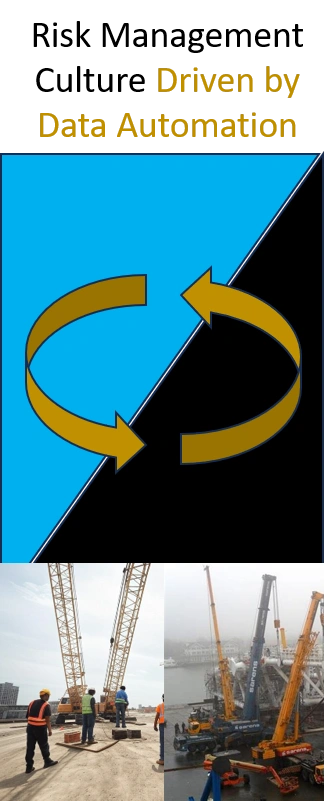
The top-down approach excels when leadership aligns resources and intent with clear, actionable safety goals—successes show how structure and investment can prevent disasters. However, its rigidity and potential to alienate frontline workers can backfire, especially in dynamic construction environments where crane operations demand adaptability. Failures often stem from a gap between management's vision and the gritty reality of the field, highlighting the need for balance (e.g., bottom-up feedback loops). Bottom-up feedback is essential not only from the field personnel but from the equipment itself. Providing real-time feedback and analysis of the crane operation can provide predictive actionable data that does not exist today. Notification of pending issues to management and the operators can help save lives and provide critical feedback in a safety success loop that can bring accident statics to a new low. Risk Data Analytics, Inc. creates and provides the technology solutions to streamline information balance and establish the safety feedback loop.
Share this post: