
Safety Information
Twenty safety tips for linemen, in order, from the CertLok Safety Tip series. Each tip has a short checklist, a bottom line, and the source behind it. Share them with your crew.
Terms used on this page: OSHA means Occupational Safety and Health Administration; CFR means Code of Federal Regulations (eCFR is the electronic, online version); FR means flame-resistant; kV means kilovolts; ANSI means American National Standards Institute; ISEA means International Safety Equipment Association; CPR means cardiopulmonary resuscitation; FAQ means frequently asked questions.
General safety information only. Always follow your employer's safety program and the official OSHA standards.
Keep your safety certifications in one digital wallet on your phone, ready to share in seconds.
Download CertLok freeSign up for Insights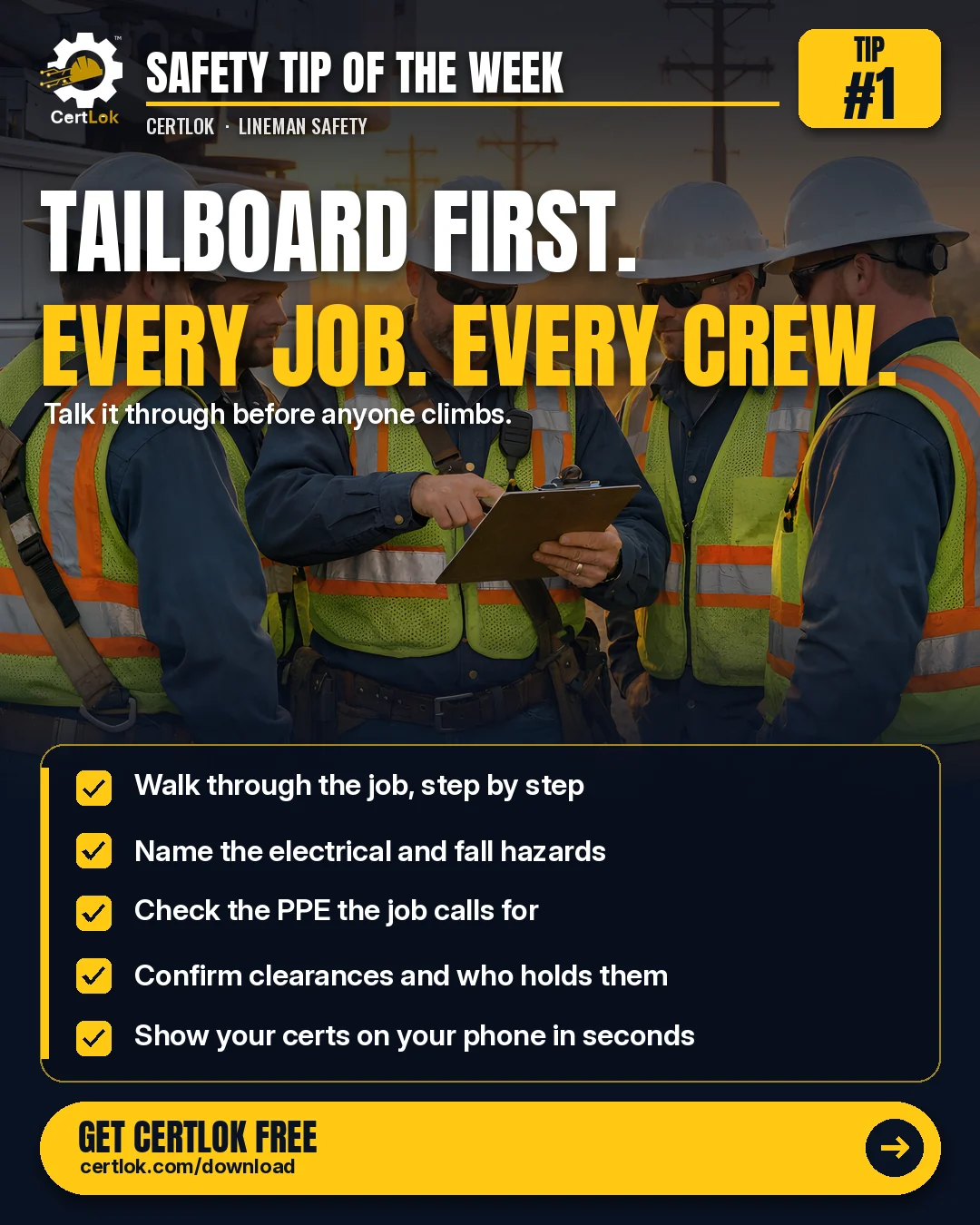
Every good tailboard starts with a crew that's trained, and can prove it. With CertLok, linemen keep their certifications in one digital wallet on their phone and share them in seconds. No texting photo copies. No "I'll bring it tomorrow."
Then the crew can focus on the job in front of them.
Rules from the Occupational Safety and Health Administration (OSHA) say the person in charge must hold a job briefing with the crew before each job. It has to cover the hazards, the work steps, special precautions, energy-source controls, and the personal protective equipment (PPE) the job needs.
Before anyone climbs:
Bottom line: the five minutes you spend at the tailboard are the cheapest safety gear on the truck.
Linemen, groundmen, and more all count on that briefing. So hold it every time, and keep your certifications current and in one place with CertLok.
Source: OSHA, 29 CFR 1910.269(c), job briefing (also 1926.952 for construction)
Rubber gloves are only as good as the lineman checking them, and that lineman should be able to prove their training. With CertLok, linemen keep their certifications in one digital wallet on their phone and share them in seconds. No texting photo copies. No "I'll bring it tomorrow."
Then the crew can focus on the gloves in their hands.
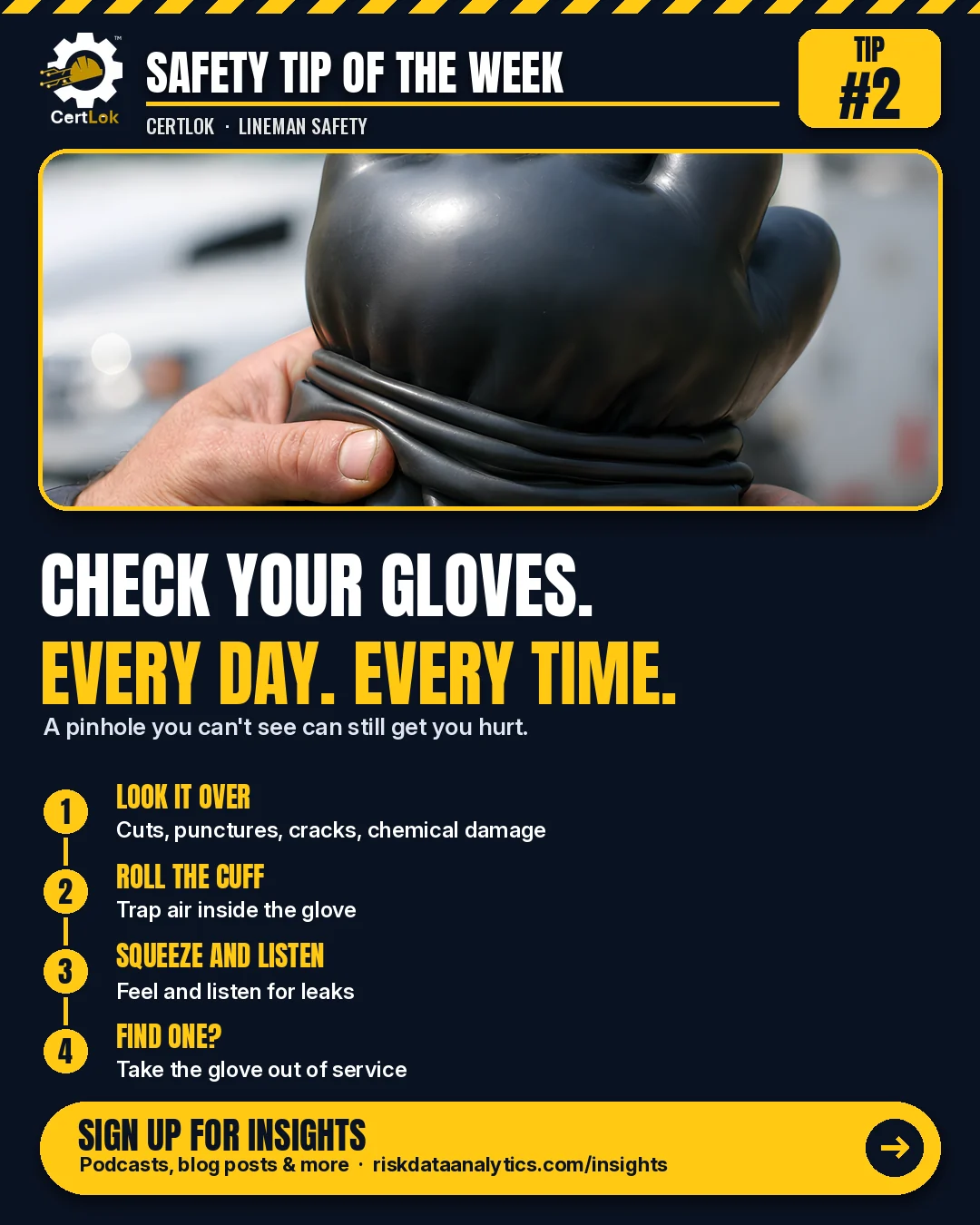
Rules from the Occupational Safety and Health Administration (OSHA) say rubber insulating gear must be inspected for damage before each day's use, and after anything that might have damaged it. Rubber insulating gloves also get an air test along with that inspection.
Every day, before you glove up:
Bottom line: a quick glove check beats finding a pinhole the hard way.
Linemen, groundmen, and more all count on good rubber. So check it every day, and keep your certifications current and in one place with CertLok.
Source: OSHA, 29 CFR 1910.137(c)(2)(ii), electrical protective equipment
The crew handling energized lines should be trained, and able to show it. With CertLok, linemen keep their certifications in one digital wallet on their phone and share them in seconds. No texting photo copies. No "I'll bring it tomorrow."
Then the crew can focus on keeping that rubber in one piece.
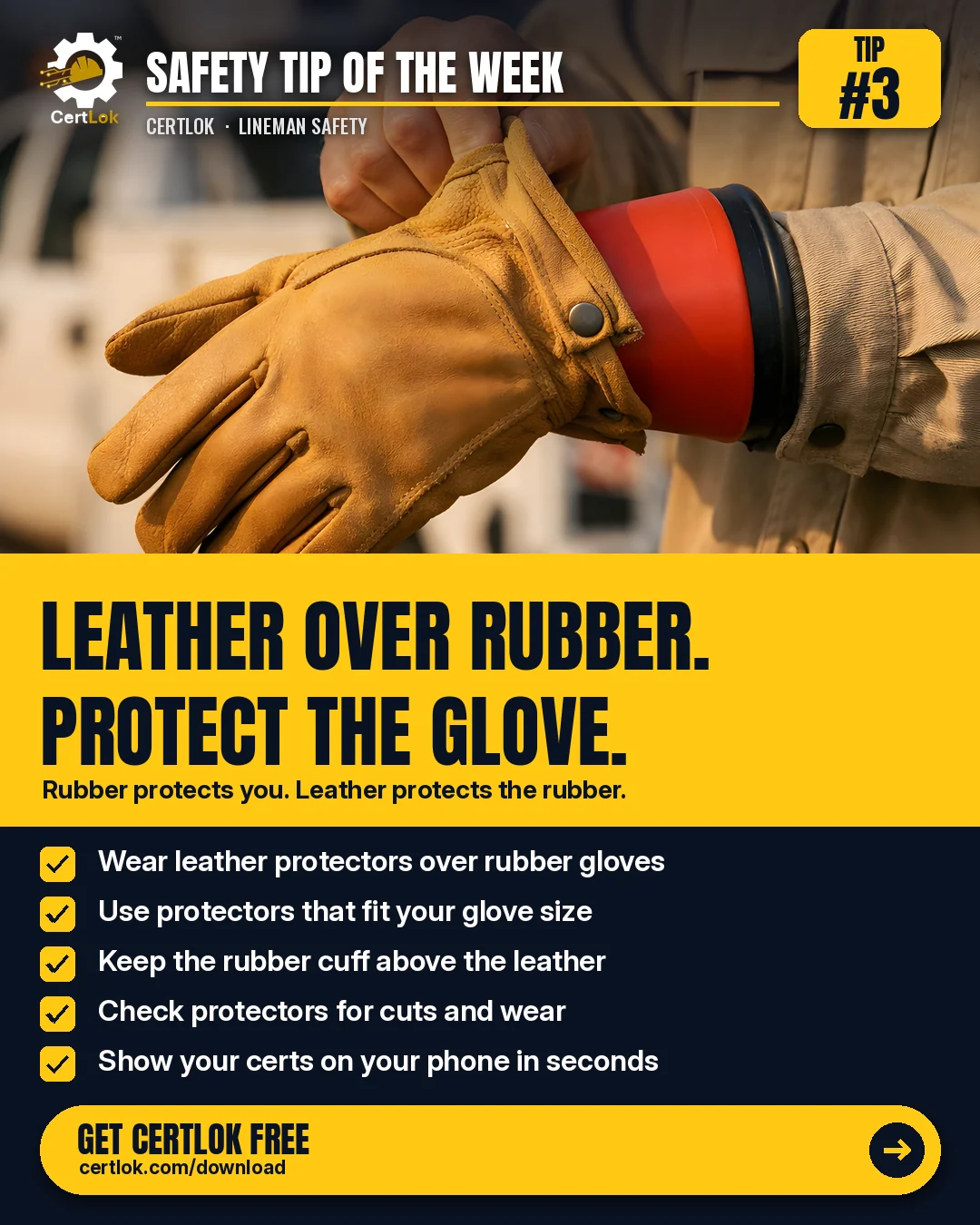
Rules from the Occupational Safety and Health Administration (OSHA) say protector gloves must be worn over rubber insulating gloves. There are only a few narrow exceptions for fine handwork, and gloves used without protectors must be tested again before anyone uses them.
Every time you glove up:
Bottom line: rubber protects you. Leather protects the rubber.
Linemen, groundmen, and more all count on that rubber. So cover it every time, and keep your certifications current and in one place with CertLok.
Source: OSHA, 29 CFR 1910.137(c)(2)(vii), electrical protective equipment
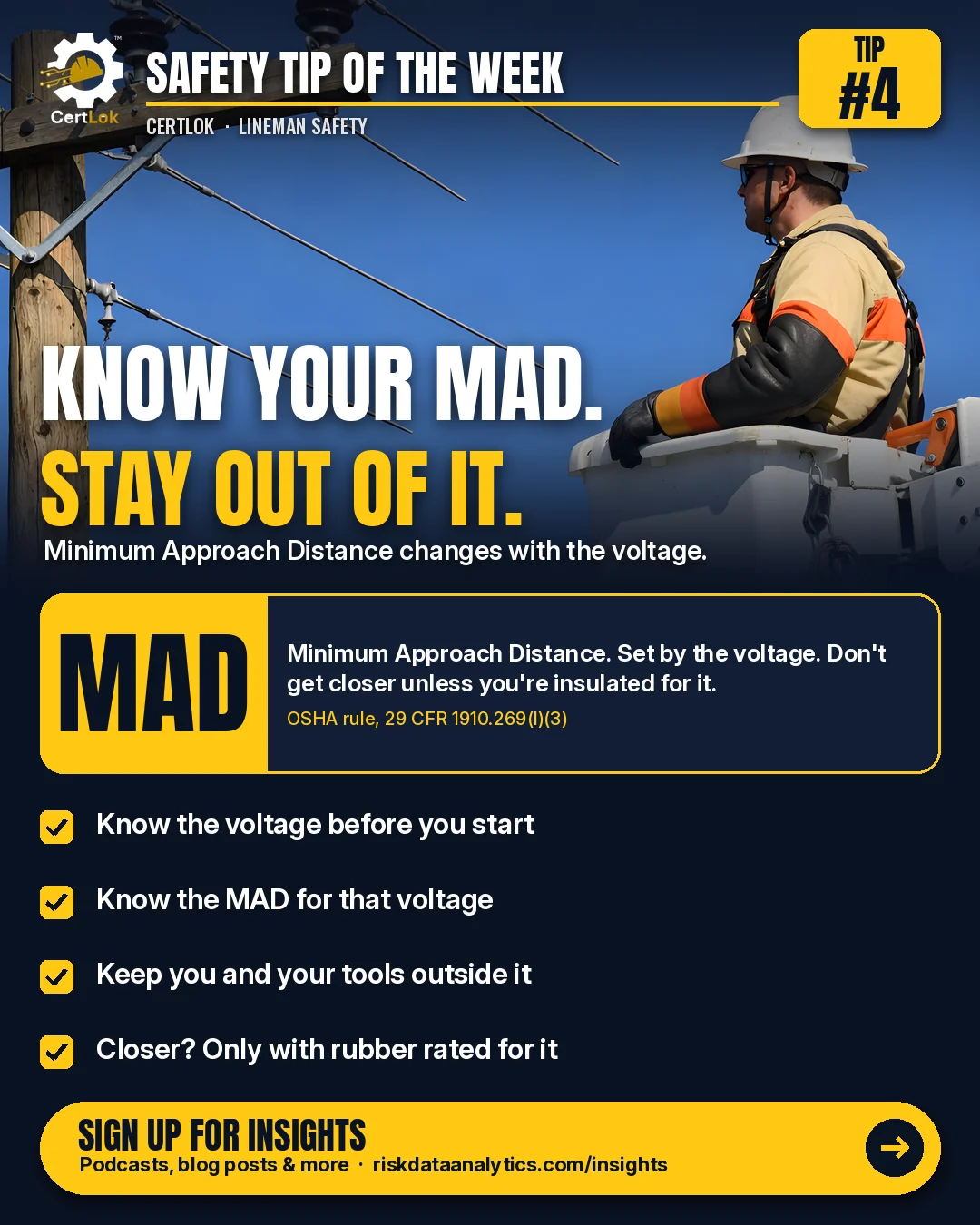
Working near energized lines takes a lineman who's qualified, and can prove it. With CertLok, linemen keep their certifications in one digital wallet on their phone and share them in seconds. No texting photo copies. No "I'll bring it tomorrow."
Then the crew can focus on the space between them and the line.
Rules from the Occupational Safety and Health Administration (OSHA) set a Minimum Approach Distance (MAD) based on the voltage. No one can get closer to exposed energized parts, or bring a conductive object closer, unless they're insulated from the part (like rubber gloves and sleeves rated for the voltage), the part is insulated from them, or they're doing approved live-line barehand work.
Every job near energized lines:
Bottom line: the line doesn't care how good you are. Respect the distance.
Linemen, groundmen, and more all work inside that math. So know your MAD every job, and keep your certifications current and in one place with CertLok.
Source: OSHA, 29 CFR 1910.269(l)(3)(iii) and Tables R-3 to R-6 (also 1926.960(c))
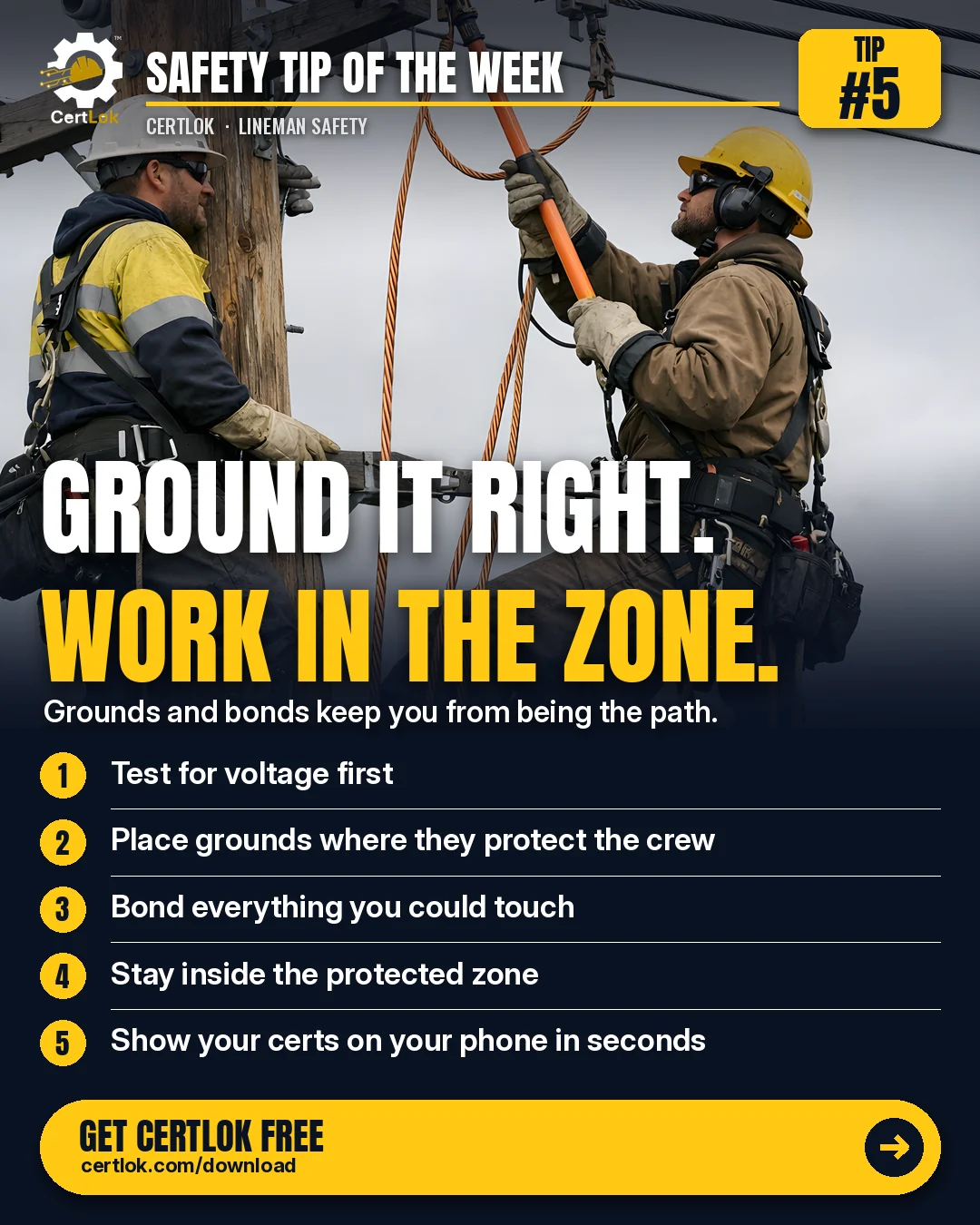
De-energized work still takes a crew that's trained, and can prove it. With CertLok, linemen keep their certifications in one digital wallet on their phone and share them in seconds. No texting photo copies. No "I'll bring it tomorrow."
Then the crew can focus on where the grounds go.
Rules from the Occupational Safety and Health Administration (OSHA) say temporary protective grounds must be placed and arranged so no worker is exposed to a dangerous difference in voltage. That's your equipotential zone (EPZ). A dead line can be re-energized by mistake, pick up induced voltage from a nearby line, or get hit by lightning.
Before you work a de-energized line:
Bottom line: a grounded line isn't the goal. A crew that can't become the path is.
Linemen, groundmen, and more all work inside that zone. So build it right every time, and keep your certifications current and in one place with CertLok.
Source: OSHA, 29 CFR 1910.269(n)(3) and Appendix C (also 1926.962(c))
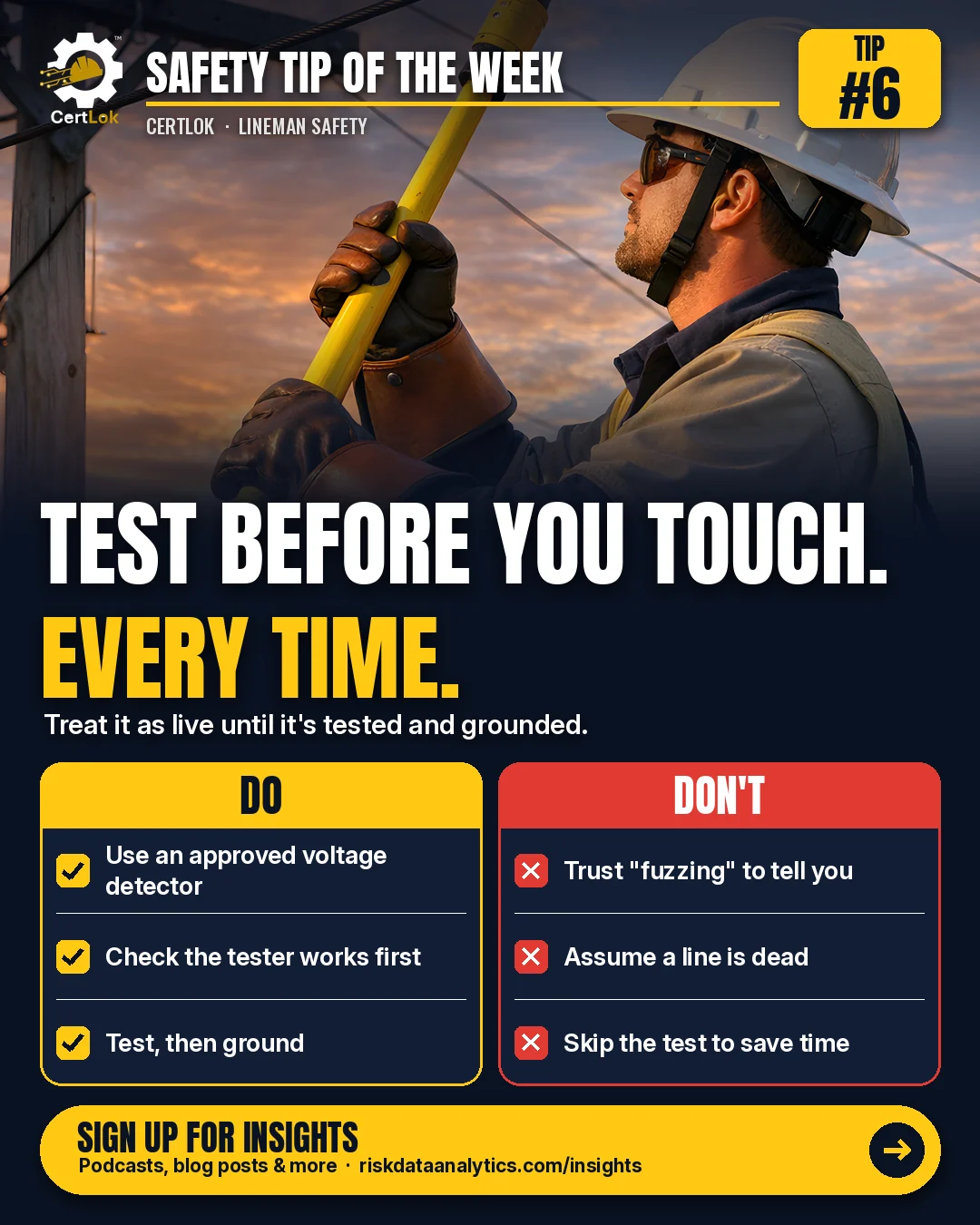
Testing a line takes a lineman who knows how, and can prove it. With CertLok, linemen keep their certifications in one digital wallet on their phone and share them in seconds. No texting photo copies. No "I'll bring it tomorrow."
Then the crew can focus on the tester in their hand.
Rules from the Occupational Safety and Health Administration (OSHA) say lines and equipment are treated as energized until they're de-energized the right way. Before installing any ground, the crew must test and confirm there's no nominal voltage, unless a ground is already in place.
Before you touch or ground:
Bottom line: live until proven dead. Prove it with the right tester.
Linemen, groundmen, and more all count on that test. So test every time, and keep your certifications current and in one place with CertLok.
Source: OSHA, 29 CFR 1910.269(l)(1)(iii) and (n)(5) (also 1926.962(e))
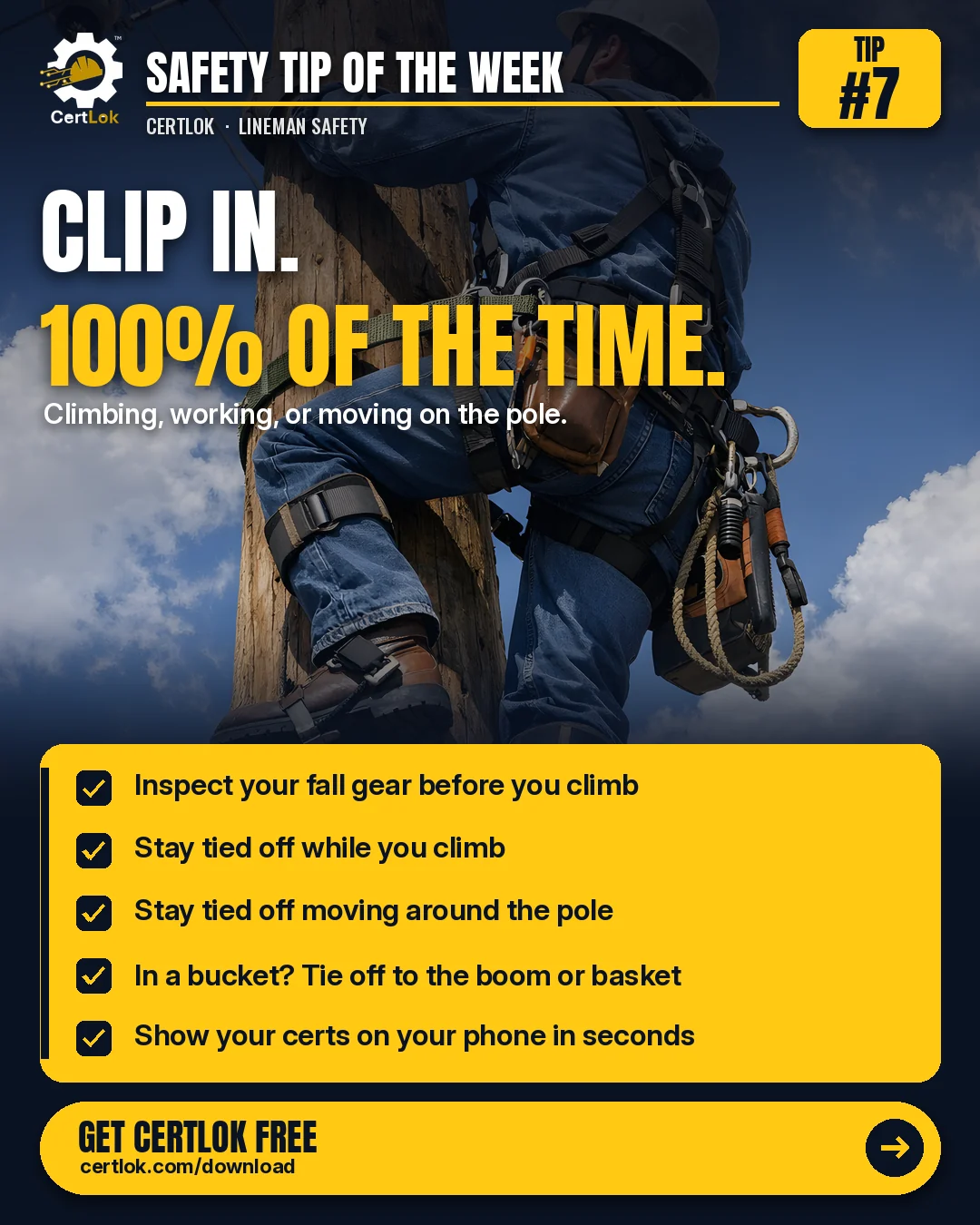
Climbing takes a lineman who's trained, and can prove it. With CertLok, linemen keep their certifications in one digital wallet on their phone and share them in seconds. No texting photo copies. No "I'll bring it tomorrow."
Then the crew can focus on staying tied off.
Rules from the Occupational Safety and Health Administration (OSHA) say qualified linemen climbing or changing position on poles, towers, or similar structures must use fall protection, unless the employer can show it isn't possible or would be more dangerous. Trainees and anyone not qualified must use it any time they're more than 4 feet off the ground. In a bucket, it's fall arrest or travel restraint, every time.
Every climb:
Bottom line: 100% tied off means 100% of the time, not most of the climb.
Linemen, groundmen, and more all go home on that rule. So clip in every time, and keep your certifications current and in one place with CertLok.
Source: OSHA, 29 CFR 1910.269(g)(2)(iv)(C) (also 1926.954(b)(3)(iii))
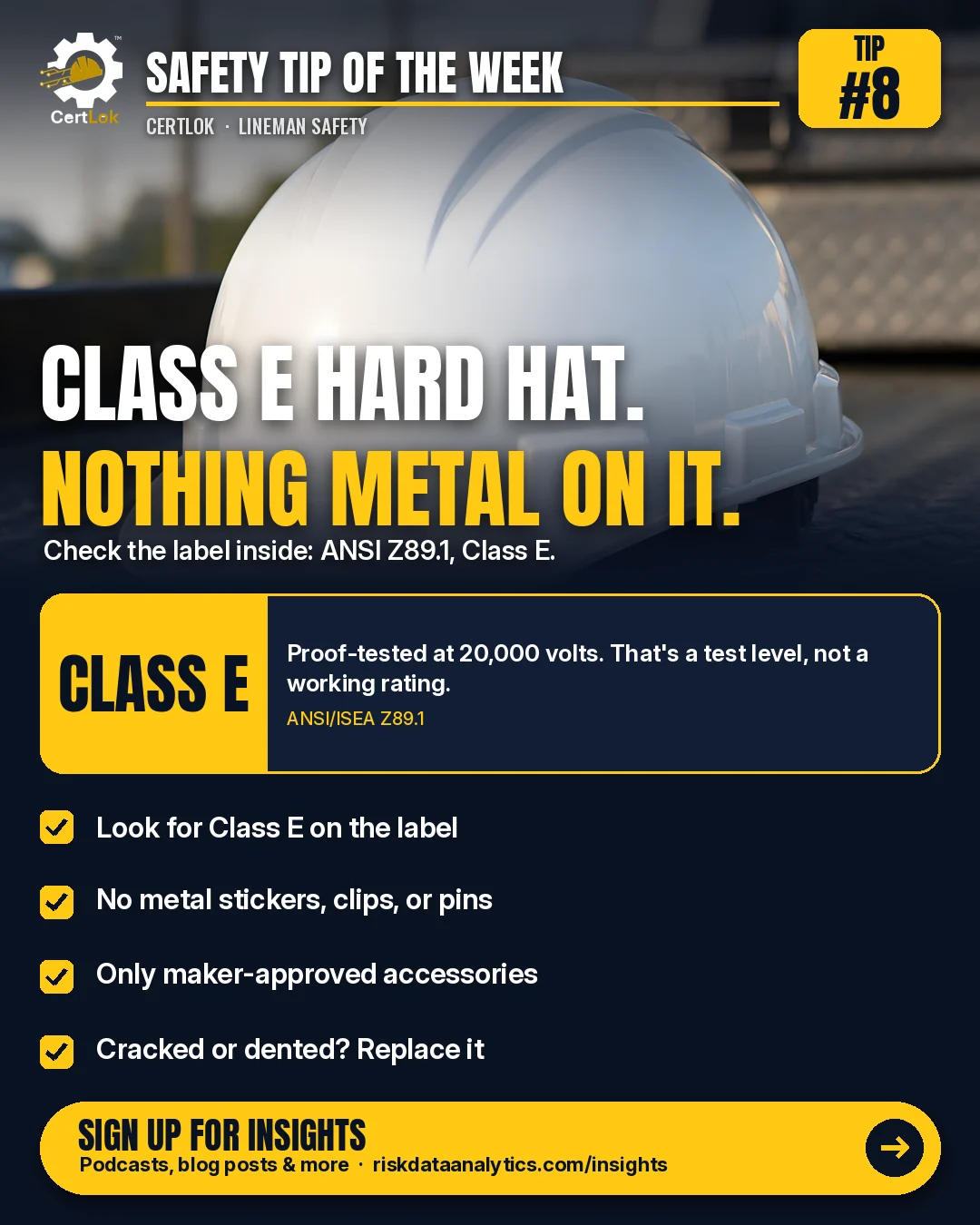
The right hard hat is one piece. A qualified crew is the rest. With CertLok, linemen keep their certifications in one digital wallet on their phone and share them in seconds. No texting photo copies. No "I'll bring it tomorrow."
Then the crew can focus on the right gear on their heads.
Rules from the Occupational Safety and Health Administration (OSHA) say workers near exposed electrical conductors that could contact the head must wear a hard hat designed to reduce shock hazard. Class E hard hats under the ANSI/ISEA Z89.1 standard are proof-tested at 20,000 volts. That's a test level, not the voltage they'll protect you from. Hard hat makers warn against metal stickers, metal accessories, and changes to the shell.
Before every shift:
Bottom line: your hard hat is part of your protection. Don't add anything that conducts.
Linemen, groundmen, and more all wear one. So check yours every shift, and keep your certifications current and in one place with CertLok.
Sources: OSHA, 29 CFR 1910.135(a)(2), head protection; OSHA Safety and Health Information Bulletin SHIB 3-6-2024, Head Protection; Maker guidance (MSA helmet FAQ; PIP hard hat guide)
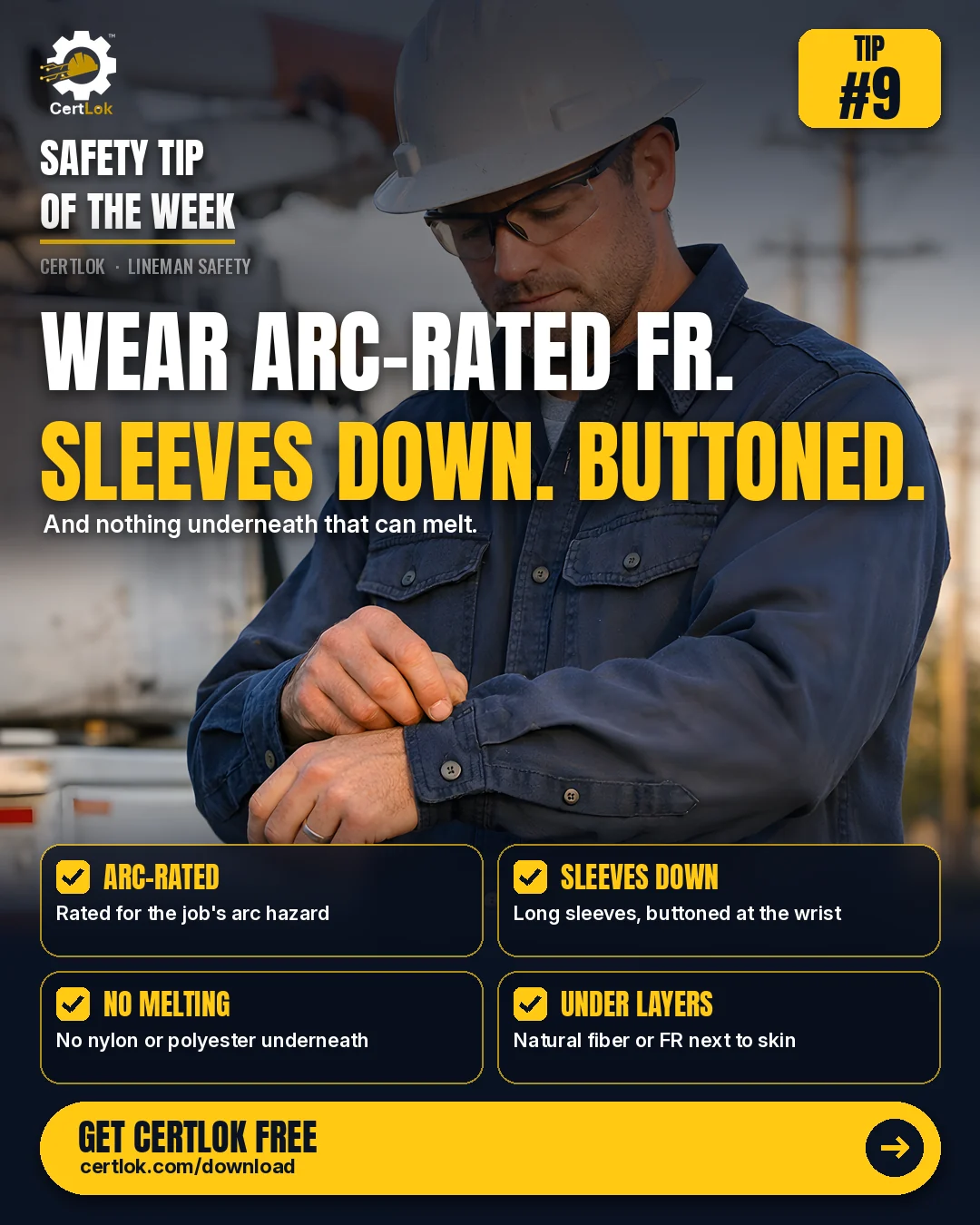
Arc flash gear only works on a crew that knows how to wear it, and can prove their training. With CertLok, linemen keep their certifications in one digital wallet on their phone and share them in seconds. No texting photo copies. No "I'll bring it tomorrow."
Then the crew can focus on what they're wearing.
Rules from the Occupational Safety and Health Administration (OSHA) say workers exposed to flames or electric arcs can't wear clothing that could melt onto their skin or keep burning, like acetate, nylon, polyester, rayon, or polypropylene. When the estimated arc heat on the job is more than 2 calories per square centimeter, workers need arc-rated clothing rated at least that high, covering the whole body.
Before you work near energized lines:
Bottom line: FR on the outside doesn't help if what's underneath melts.
Linemen, groundmen, and more all dress for the arc. So gear up right every time, and keep your certifications current and in one place with CertLok.
Source: OSHA, 29 CFR 1910.269(l)(8)(iii) and (l)(8)(v) (also 1926.960(g))
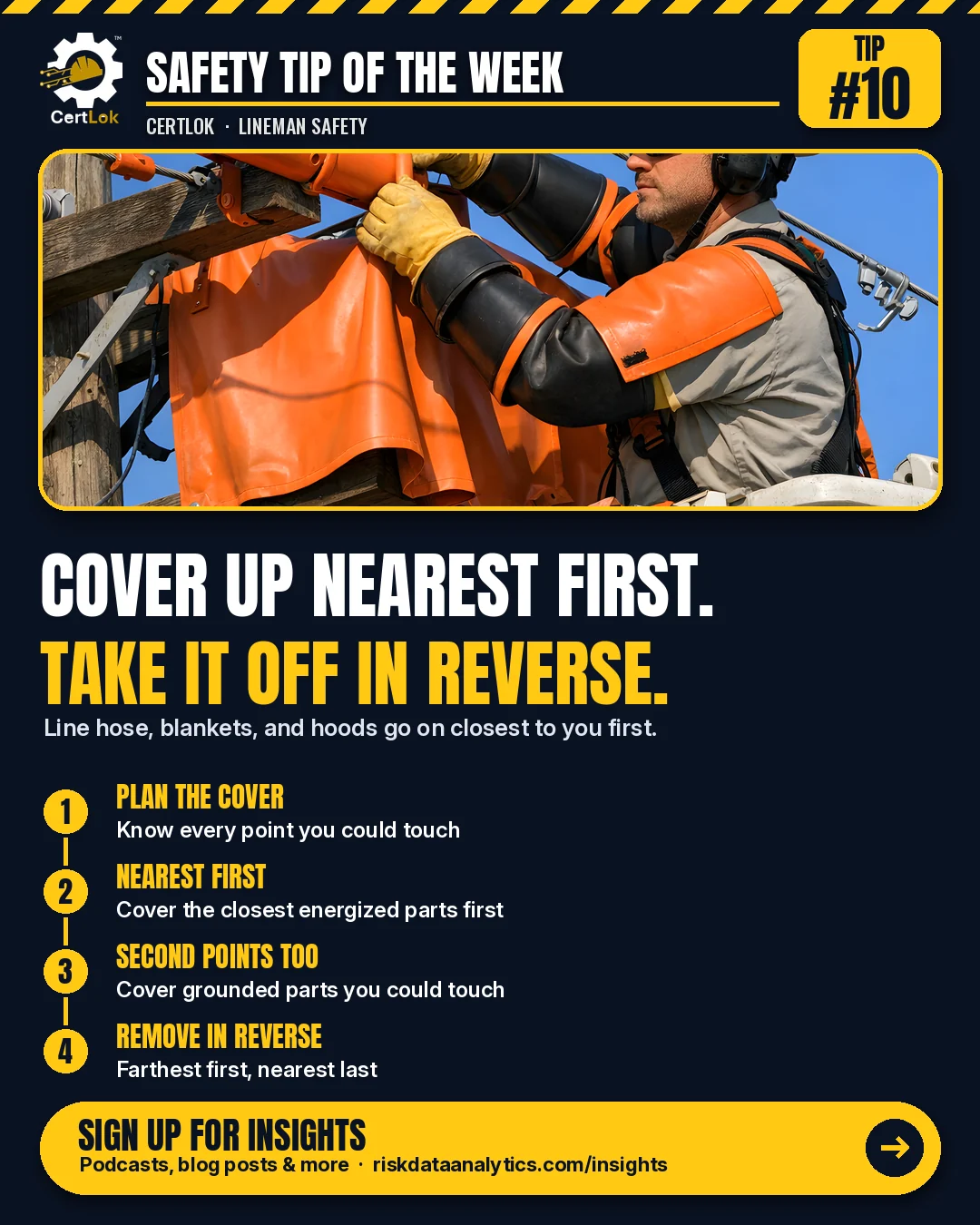
Covering up a live line takes a lineman who's trained, and can prove it. With CertLok, linemen keep their certifications in one digital wallet on their phone and share them in seconds. No texting photo copies. No "I'll bring it tomorrow."
Then the crew can focus on covering up in the right order.
Rules from the Occupational Safety and Health Administration (OSHA) say a worker can only get inside the Minimum Approach Distance if they're insulated from the energized part, or the part is insulated from them. Putting cover-up on nearest first, and taking it off in reverse, keeps you protected at every step.
When you cover up:
Bottom line: cover the closest danger first, and uncover it last.
Linemen, groundmen, and more all count on good cover-up. So do it in order every time, and keep your certifications current and in one place with CertLok.
Source: OSHA, 29 CFR 1910.269(l)(3)(iii), minimum approach distance (also 1926.960(c))
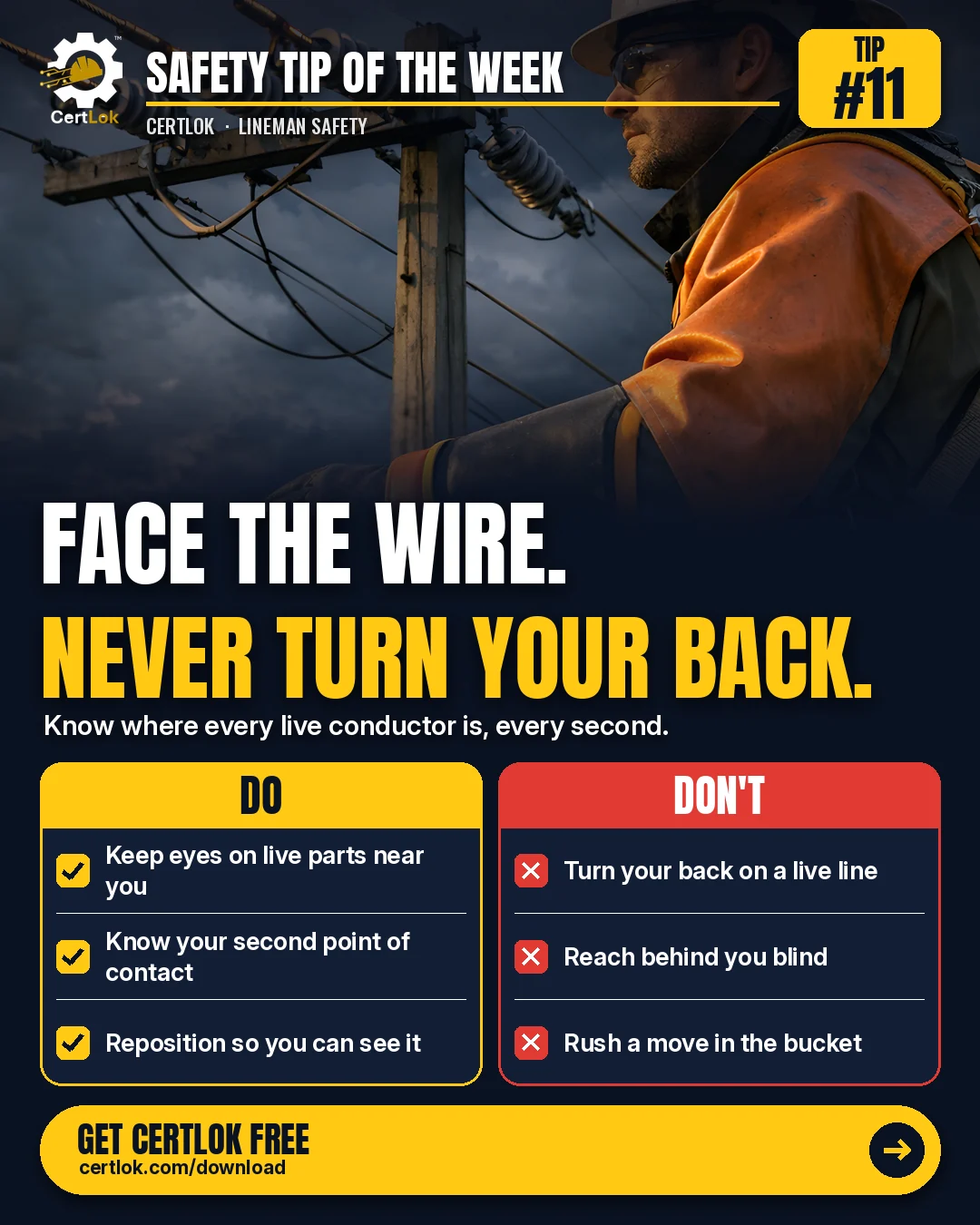
Working close to live conductors takes a lineman who's qualified, and can prove it. With CertLok, linemen keep their certifications in one digital wallet on their phone and share them in seconds. No texting photo copies. No "I'll bring it tomorrow."
Then the crew can focus on where the live parts are.
Rules from the Occupational Safety and Health Administration (OSHA) say no one can get inside the Minimum Approach Distance to exposed energized parts unless they're insulated from them. It's hard to keep that distance from a conductor you can't see.
When you're working near exposed live conductors:
Bottom line: if you can't see it, you can't stay clear of it.
Linemen, groundmen, and more all count on that awareness. So face the wire every time, and keep your certifications current and in one place with CertLok.
Source: OSHA, 29 CFR 1910.269(l)(3)(iii), minimum approach distance
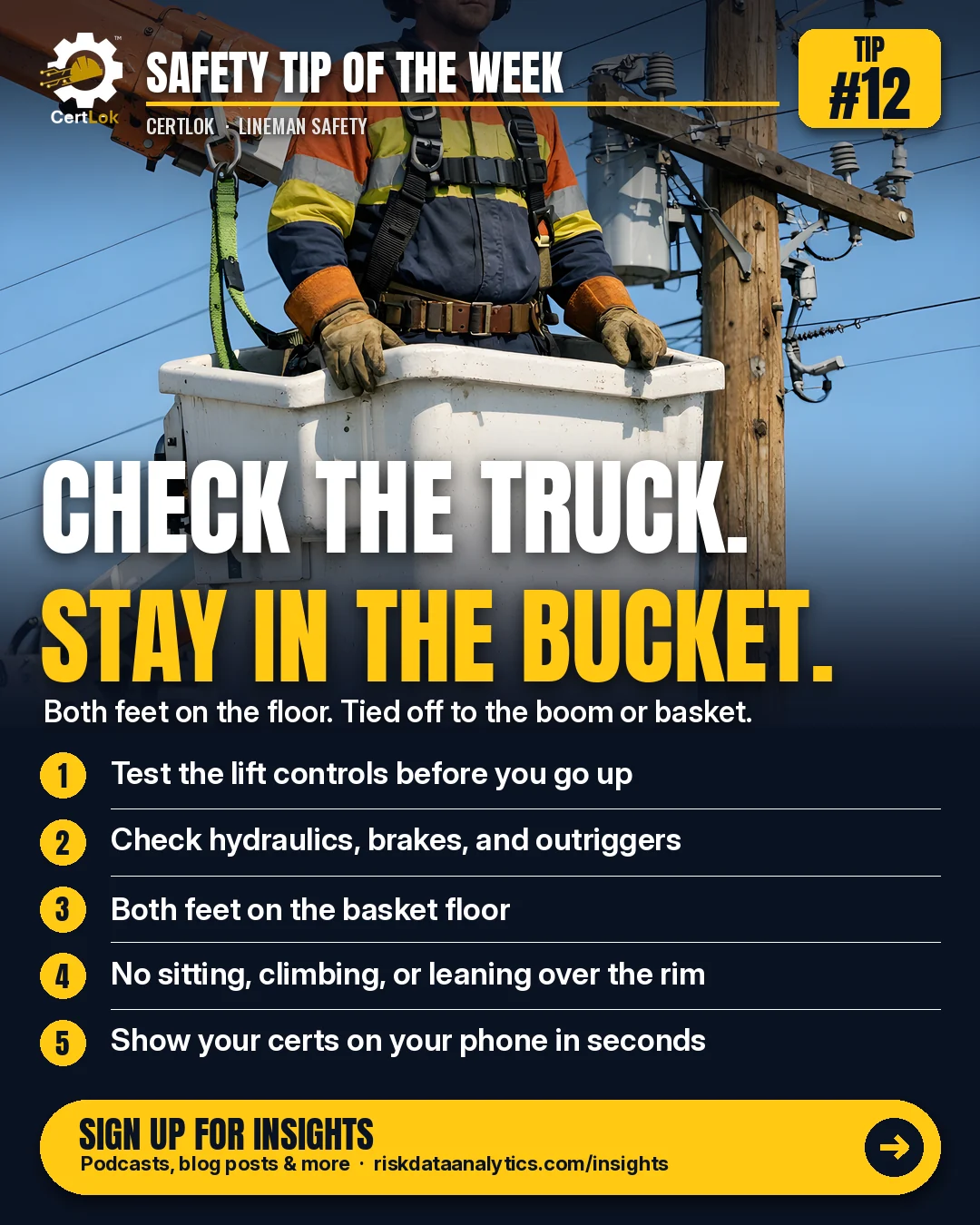
A bucket truck needs an operator who's trained, and can prove it. With CertLok, linemen keep their certifications in one digital wallet on their phone and share them in seconds. No texting photo copies. No "I'll bring it tomorrow."
Then the crew can focus on the truck and the basket.
Rules from the Occupational Safety and Health Administration (OSHA) say aerial lift controls must be tested each day before use, the brakes set, and outriggers placed on pads or solid ground. Workers must always stand firmly on the basket floor and never sit or climb on the edge. A fall arrest or travel restraint system must be worn and attached to the boom or basket.
Before you go up:
Bottom line: the bucket is your work platform. The rim isn't.
Linemen, groundmen, and more all count on that truck. So check it every day, and keep your certifications current and in one place with CertLok.
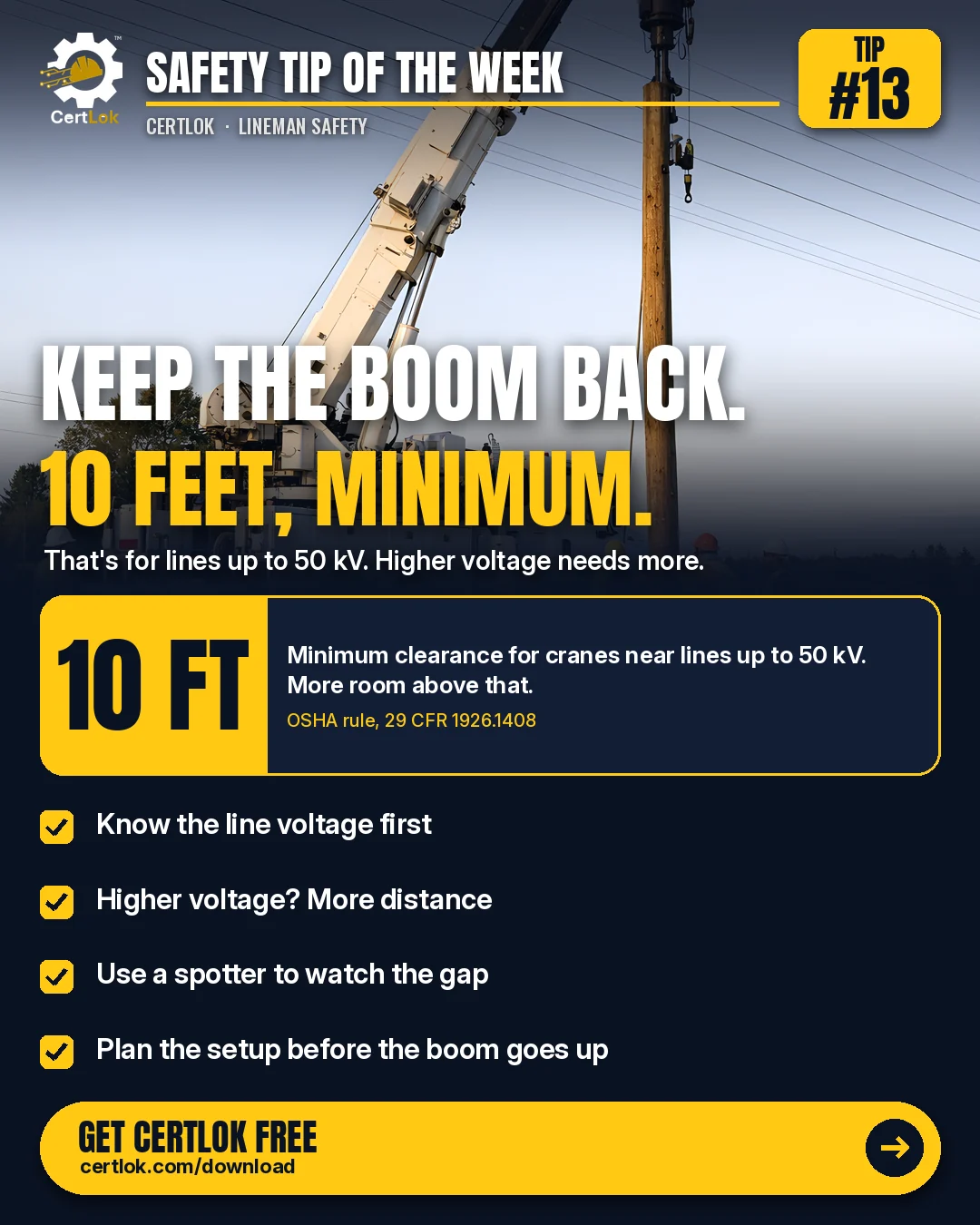
Running a boom near power lines takes an operator who's qualified, and can prove it. With CertLok, linemen keep their certifications in one digital wallet on their phone and share them in seconds. No texting photo copies. No "I'll bring it tomorrow."
Then the crew can focus on the gap between the boom and the line.
Rules from the Occupational Safety and Health Administration (OSHA) say cranes and similar equipment working near power lines up to 50 kV must stay at least 10 feet away. Higher voltage needs more room: 15 feet over 50 up to 200 kV, and more from there. Line crews setting poles with a digger derrick work under the power line work rules, which set distances by voltage and call for an observer.
Before the boom goes up:
Bottom line: 10 feet is the floor, not the goal.
Crane operators, linemen, groundmen, and more all work that gap. So plan it every time, and keep your certifications current and in one place with CertLok.
Sources: OSHA, 29 CFR 1926.1408, Table A, minimum clearance distances (cranes and derricks in construction); OSHA, 29 CFR 1926.1400(c)(4), scope exclusion for digger derricks; OSHA, 29 CFR 1910.269(p)(4), mechanical equipment near energized lines
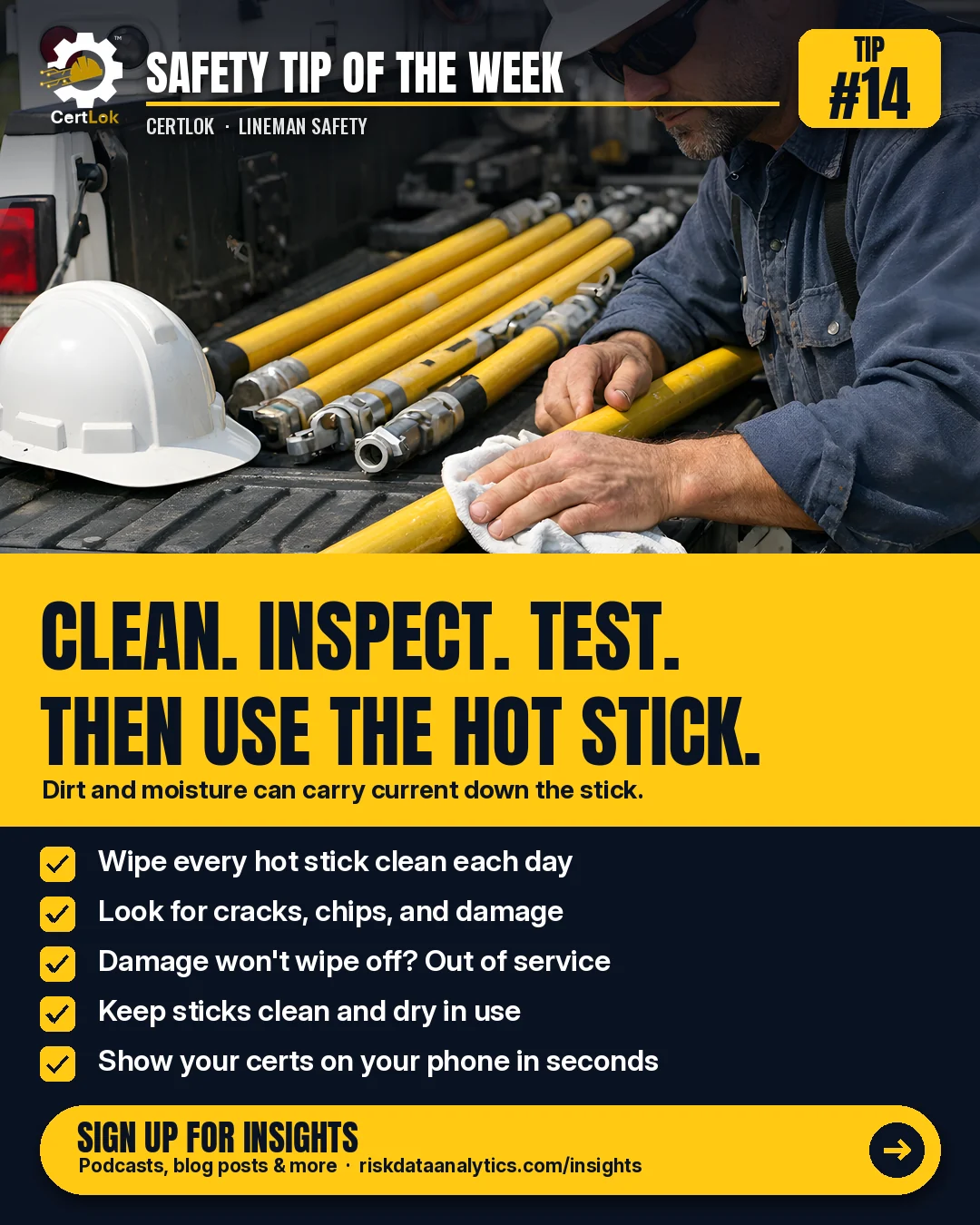
A hot stick is only as safe as the lineman using it, and that lineman should be able to prove their training. With CertLok, linemen keep their certifications in one digital wallet on their phone and share them in seconds. No texting photo copies. No "I'll bring it tomorrow."
Then the crew can focus on the tool in their hands.
Rules from the Occupational Safety and Health Administration (OSHA) say every live-line tool must be wiped clean and visually inspected for defects before use each day. If a defect or contamination is still there after wiping, the tool comes out of service until it's examined and tested. Tools used for primary protection are pulled for examination, cleaning, repair, and testing every 2 years.
Before you pick up a hot stick:
Bottom line: a dirty hot stick can carry current. Keep it clean.
Linemen, groundmen, and more all count on clean tools. So check them every day, and keep your certifications current and in one place with CertLok.
Source: OSHA, 29 CFR 1910.269(j)(2), live-line tools (also 1926.957(b))
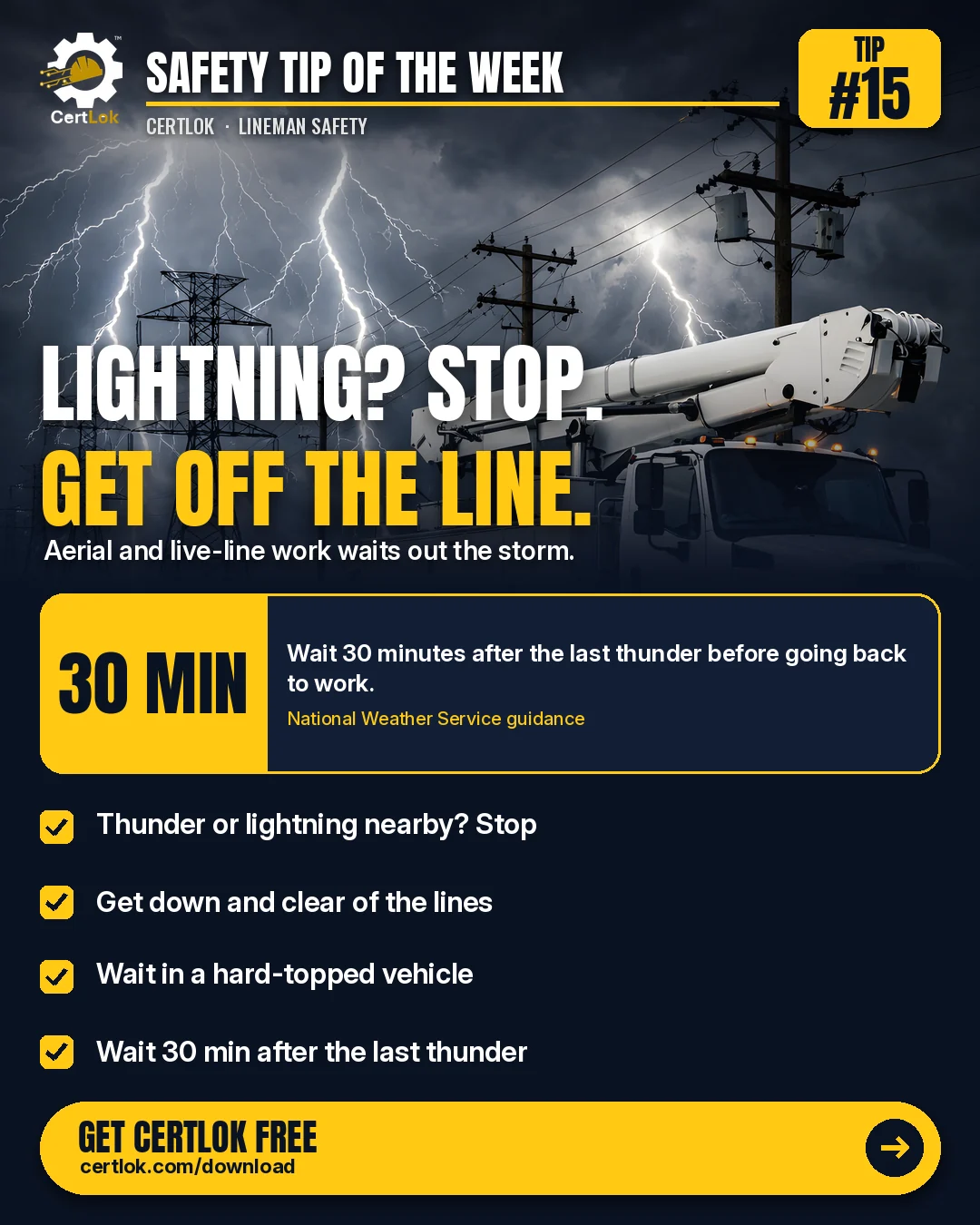
Storm calls take a crew that's trained, and can prove it. With CertLok, linemen keep their certifications in one digital wallet on their phone and share them in seconds. No texting photo copies. No "I'll bring it tomorrow."
Then the crew can focus on the sky.
Rules from the Occupational Safety and Health Administration (OSHA) say crews can't work when bad weather would make it hazardous, and they name thunderstorms in the area as an example for live-line work. The National Weather Service advises waiting 30 minutes after the last thunder before going back out.
When a storm rolls in:
Bottom line: the storm sets the schedule. Wait it out.
Linemen, groundmen, and more all work storm season. So stop when the sky says stop, and keep your certifications current and in one place with CertLok.
Sources: OSHA, 29 CFR 1910.269(q)(3)(vi) and (q)(4)(iv), with notes; National Weather Service lightning safety guidance
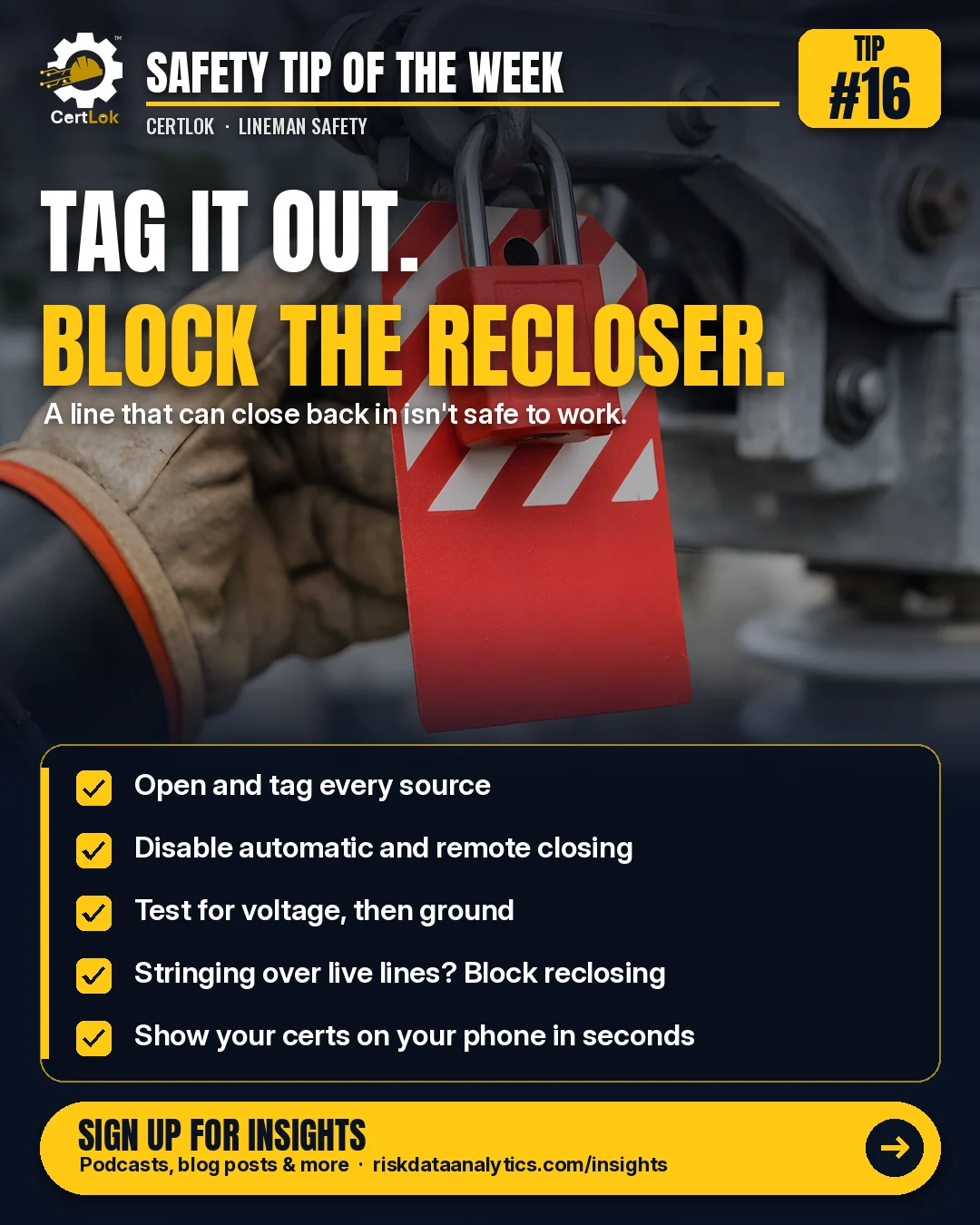
A clearance only works when the whole crew is trained, and can prove it. With CertLok, linemen keep their certifications in one digital wallet on their phone and share them in seconds. No texting photo copies. No "I'll bring it tomorrow."
Then the crew can focus on what's switched, tagged, and blocked.
Rules from the Occupational Safety and Health Administration (OSHA) say that before a line is worked de-energized, every switch that could re-energize it must be opened and tagged, and any automatic or remote closing feature made inoperable where the design allows. When new conductors are strung across energized lines over 600 volts, the automatic reclosing on those lines must be blocked if the design allows. The same goes for live-line barehand work.
Before you work a de-energized line:
Bottom line: if it can close back in, it isn't dead.
Linemen, groundmen, and more all count on that clearance. So tag it right every time, and keep your certifications current and in one place with CertLok.
Sources: OSHA, 29 CFR 1910.269(m)(3), deenergizing lines and equipment (also 1926.961); OSHA, 29 CFR 1910.269(q)(2)(iii) stringing, and (q)(3)(v) live-line barehand
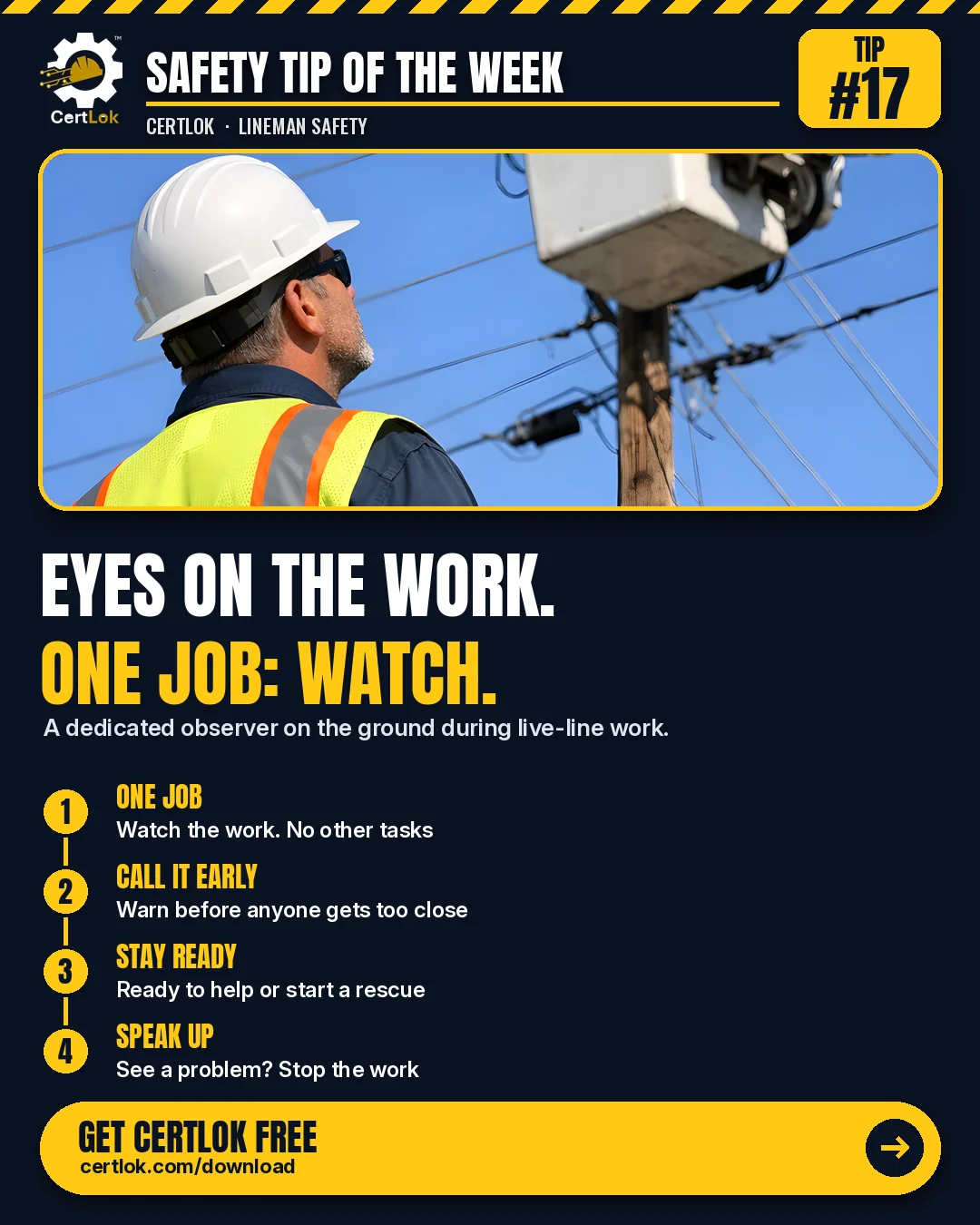
The person watching from the ground should be as trained as the person in the air, and able to prove it. With CertLok, linemen keep their certifications in one digital wallet on their phone and share them in seconds. No texting photo copies. No "I'll bring it tomorrow."
Then the crew can focus on the work overhead.
Rules from the Occupational Safety and Health Administration (OSHA) say that when trucks or other equipment work near exposed energized lines, someone other than the operator must watch the distance and warn before the Minimum Approach Distance is reached, unless the operator can clearly see it. Many utilities go further and require a dedicated ground observer for all live-line work.
During live-line work:
Bottom line: the person on the ground sees what the person in the air can't.
Linemen, groundmen, and more all need a second set of eyes. So keep one on the ground every time, and keep your certifications current and in one place with CertLok.
Source: OSHA, 29 CFR 1910.269(p)(4), mechanical equipment near energized lines (also 1926.959(d))
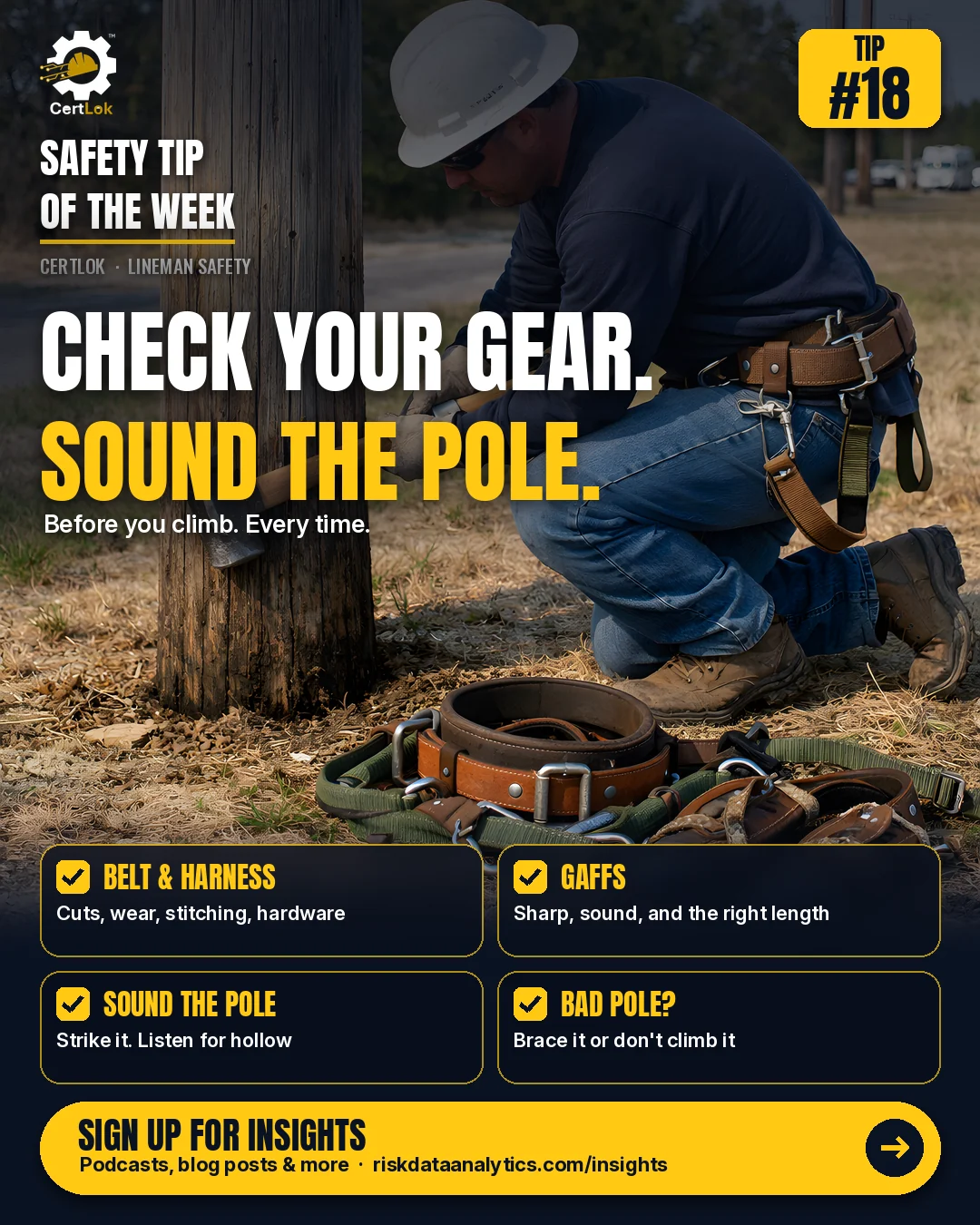
Every climb starts with a lineman who's trained, and can prove it. With CertLok, linemen keep their certifications in one digital wallet on their phone and share them in seconds. No texting photo copies. No "I'll bring it tomorrow."
Then the crew can focus on the gear and the pole.
Rules from the Occupational Safety and Health Administration (OSHA) say work-positioning equipment must be inspected before use each day. Before anyone climbs, the employer must make sure the pole can take the extra stress. If it can't, the pole has to be braced or supported.
Before you climb:
Bottom line: a pole that sounds hollow is telling you something. Listen.
Linemen, groundmen, and more all count on good gear and a sound pole. So check both every time, and keep your certifications current and in one place with CertLok.
Source: OSHA, 29 CFR 1910.269(g)(2)(iv)(A) and (q)(1)(i) with Appendix D (also 1926.954, 1926.964)
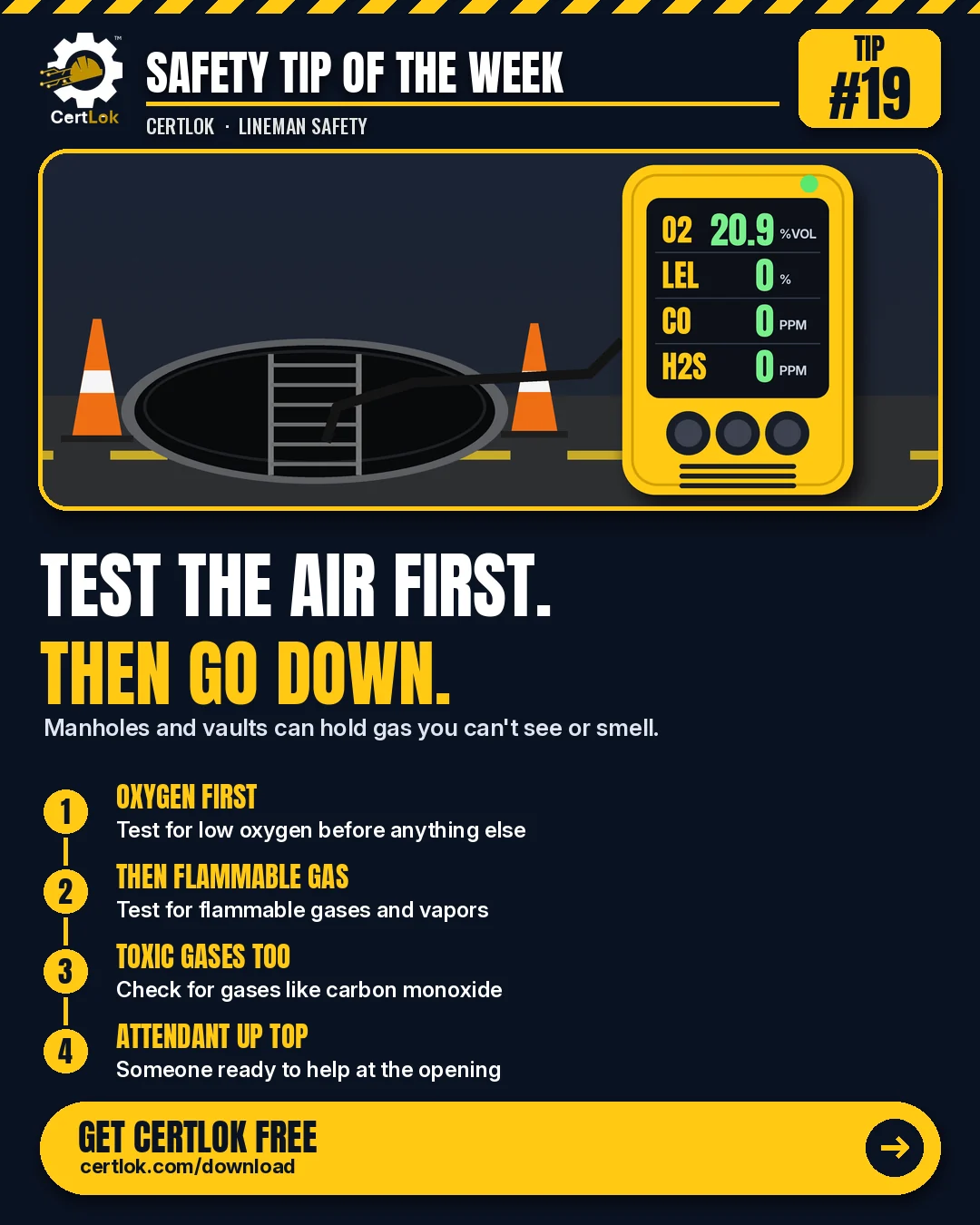
Going below grade takes a crew that's trained, and can prove it. With CertLok, linemen keep their certifications in one digital wallet on their phone and share them in seconds. No texting photo copies. No "I'll bring it tomorrow."
Then the crew can focus on the air below.
Rules from the Occupational Safety and Health Administration (OSHA) say the air in an enclosed space like a manhole or vault must be tested for low oxygen before anyone goes in, then for flammable gases and vapors. When work is done in a manhole or vault with energized equipment, someone with first-aid training must be on the surface near the entrance.
Before anyone goes down:
Bottom line: you can't see bad air, so test it every time.
Linemen, groundmen, and more all work below grade. So test the air every time, and keep your certifications current and in one place with CertLok.
Source: OSHA, 29 CFR 1910.269(e)(9), (e)(10), and (t)(3) (also 1926.953, 1926.965)
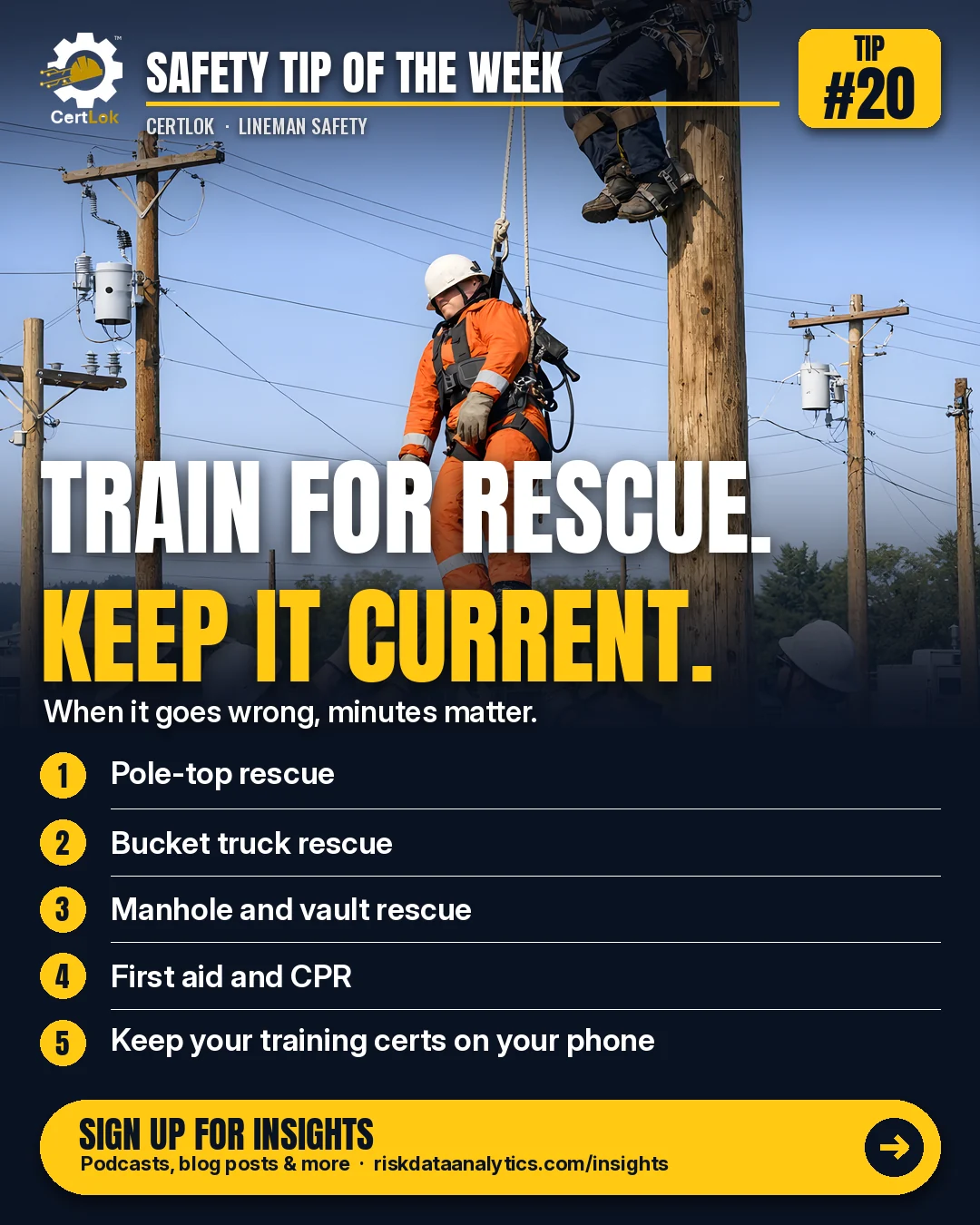
When something goes wrong up there, you want a crew that's trained, and can prove it. With CertLok, linemen keep their certifications in one digital wallet on their phone and share them in seconds. No texting photo copies. No "I'll bring it tomorrow."
Then the crew can focus on getting each other home.
Rules from the Occupational Safety and Health Administration (OSHA) say line workers must be trained in emergency procedures like pole-top and manhole rescue. When two or more workers are doing field work on lines energized at 50 volts or more, at least two people with first-aid training, including CPR, must be there.
Keep these current:
Bottom line: you don't rise to the moment. You fall back on your training.
Linemen, groundmen, and more all count on each other. So keep your rescue training current, and keep your certifications current and in one place with CertLok.
Source: OSHA, 29 CFR 1910.269(a)(2) training and (b)(1) first aid (also 1926.950(b), 1926.951(b))
Keep your safety certifications in one digital wallet on your phone, ready to share in seconds.
Download CertLok freeSign up for Insights