
Safety Information
Twenty safety tips for heavy haul drivers moving oversize and overweight loads, in order, from the CertLok Heavy Haul Safety Tip series. Each tip has a short checklist, a bottom line, and the source behind it. Share them with your crew.
Terms used on this page: DOT means U.S. Department of Transportation; FMCSA means Federal Motor Carrier Safety Administration; FHWA means Federal Highway Administration; CFR means Code of Federal Regulations (eCFR is the electronic, online version); CDL means commercial driver's license; WLL means working load limit; OSHA means Occupational Safety and Health Administration.
General safety information only. Always follow your employer's safety program and the official DOT and FMCSA rules.
Keep your safety certifications in one digital wallet on your phone, ready to share in seconds.
Download CertLok freeSign up for Insights
A safe move starts long before the wheels turn, with a driver who's trained and can prove it. With CertLok, heavy haul drivers keep their commercial driver's license (CDL) and certifications in one digital wallet on their phone and share them in seconds. No texting photo copies. No "I'll bring it tomorrow."
Then the driver can focus on the road ahead.
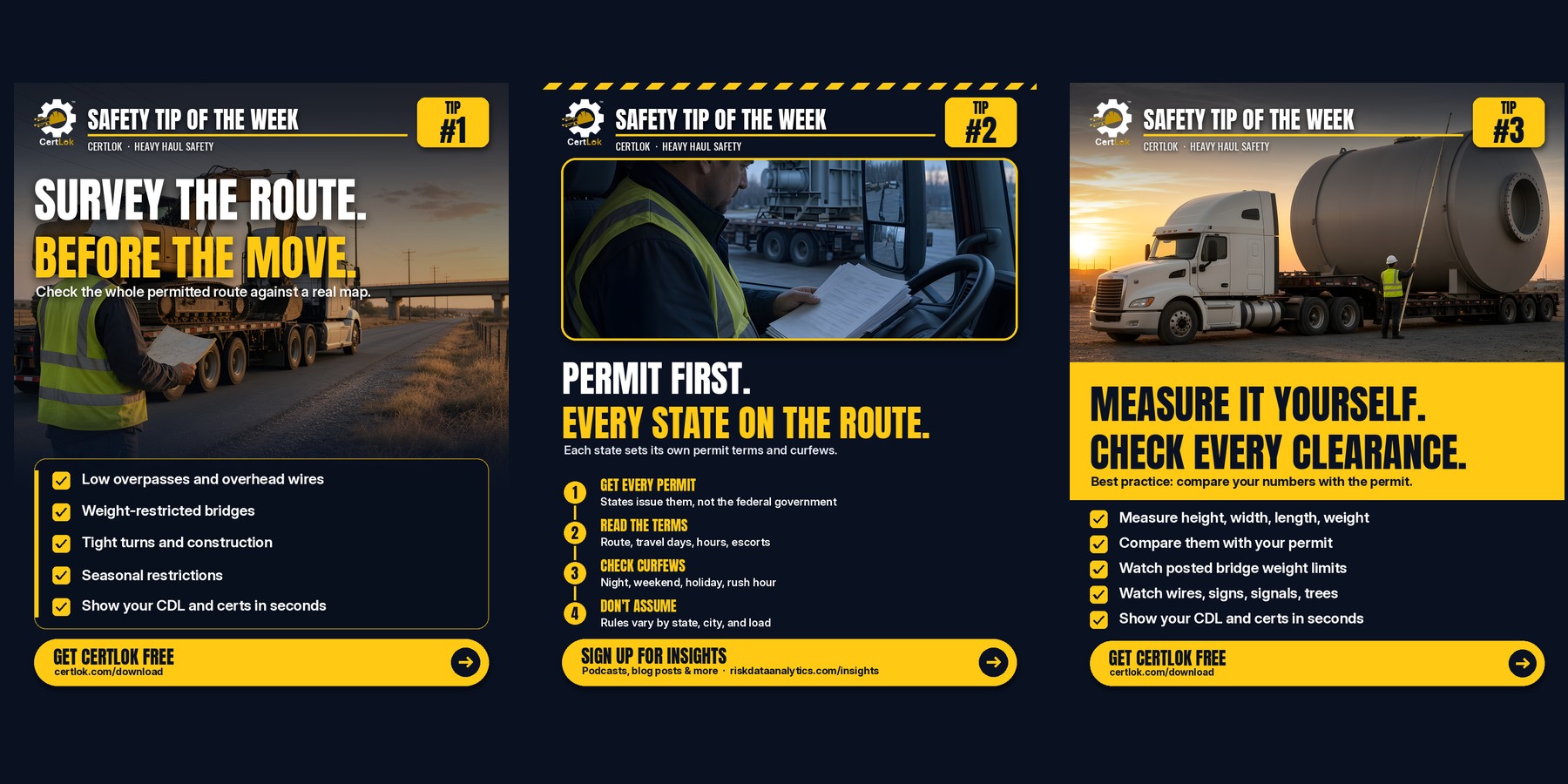
Pilot/escort best-practice guidelines from the Federal Highway Administration (FHWA) say to check the whole route before the move and compare the permitted route against an actual map. State departments of transportation publish bridge clearance, weight, and width data you can use.
Before the move, check for:
Bottom line: the surprises you find on the survey are the ones that can't hurt you on the road.
Survey every route, and keep your certifications current and in one place with CertLok.
Source: FHWA, Pilot/Escort Vehicle Operators Best Practices Guidelines (2016), Part I

Every permit has a driver's name behind it, and that driver should be able to show their credentials fast. With CertLok, heavy haul drivers keep their commercial driver's license (CDL) and certifications in one digital wallet on their phone and share them in seconds. No texting photo copies. No "I'll bring it tomorrow."
Then the driver can focus on the permit in their hands.
Federal size and weight rules in Title 23 of the Code of Federal Regulations (23 CFR) set Interstate limits of 80,000 pounds gross, 20,000 pounds on a single axle, and 34,000 pounds on a tandem axle, also limited by the federal bridge formula, and 102 inches wide. The federal government does not issue oversize or overweight permits. Each state does, and its permit sets your route, travel days and hours, escorts, and other conditions.
Before you roll:
Bottom line: curfews and permit conditions vary by state, city, and load size.
Check every permit before you roll, and keep your certifications current and in one place with CertLok.
Sources: 23 CFR 658.15 and 658.17, federal size and weight limits; FHWA, Oversize/Overweight Load Permits

Knowing your load starts with knowing your driver is qualified. With CertLok, heavy haul drivers keep their commercial driver's license (CDL) and certifications in one digital wallet on their phone and share them in seconds. No texting photo copies. No "I'll bring it tomorrow."
Then the driver can focus on every clearance on the route.
Pilot/escort best-practice guidelines from the Federal Highway Administration (FHWA) say to measure the loaded height, width, length, and weight yourself before departure and compare them with the permit. These are recommended practices. Use a height pole escort when the permit or the state requires one.
Before departure:
Bottom line: your own tape measure is the last check before the overpass.
Measure every load, and keep your certifications current and in one place with CertLok.
Source: FHWA, Pilot/Escort Vehicle Operators Best Practices Guidelines (2016), Parts I and III
Securement takes a trained driver, and the paperwork to prove it. With CertLok, heavy haul drivers keep their commercial driver's license (CDL) and certifications in one digital wallet on their phone and share them in seconds. No texting photo copies. No "I'll bring it tomorrow."
Then the driver can focus on the load behind them.
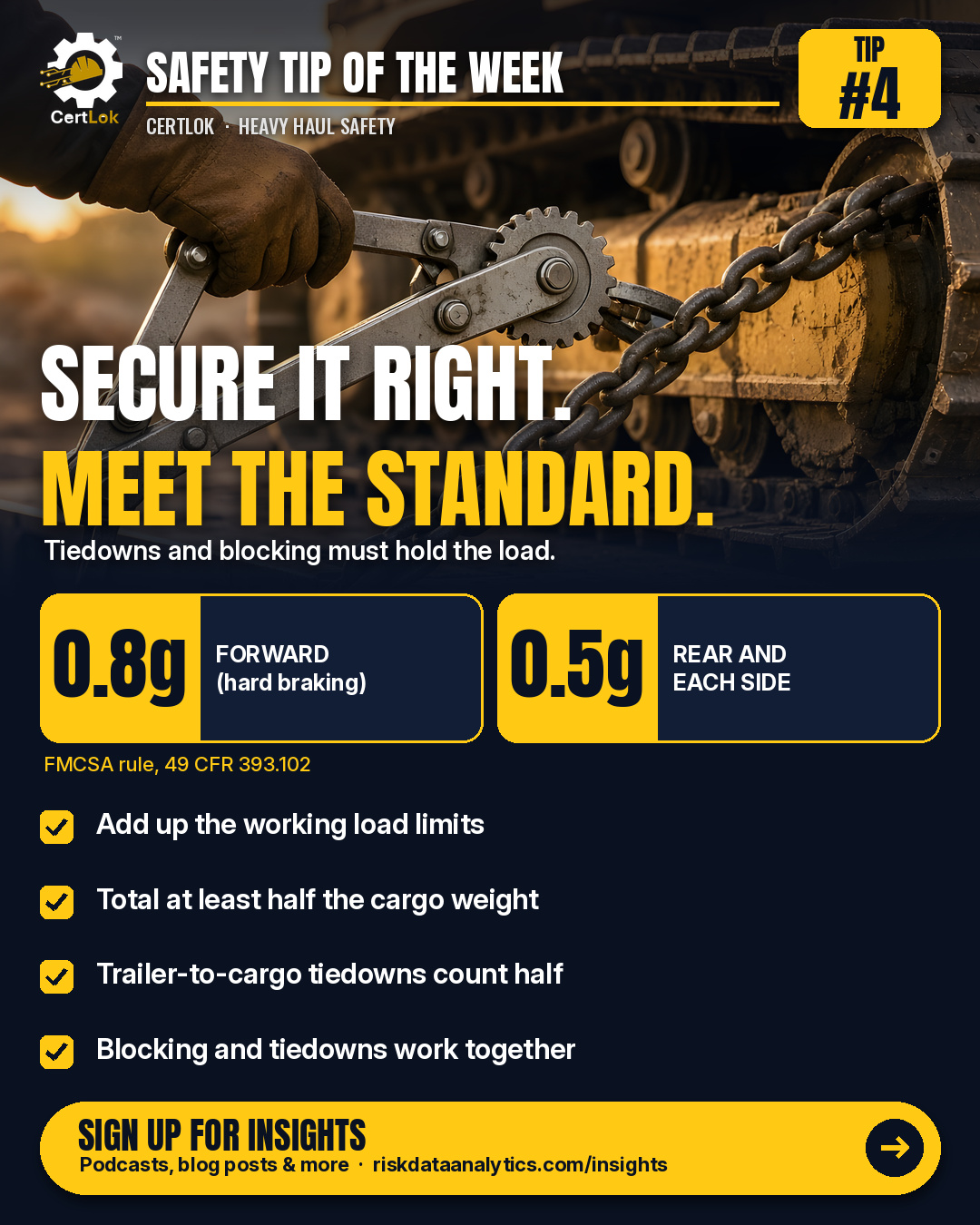
Federal Motor Carrier Safety Administration (FMCSA) rules in Title 49 of the Code of Federal Regulations (49 CFR 393.102 and 393.106) set two numbers, one for each direction. Going forward, tiedowns and blocking must hold the cargo against 0.8 times the force of gravity (0.8g), which is the push a load gets in hard braking. To the rear and to each side, they must hold against 0.5 times gravity (0.5g). Both apply to every load. The working load limits (WLL) of all tiedowns added together must be at least half the weight of the cargo.
Every load:
Bottom line: if the math doesn't add up, the load isn't secure.
Do the math on every load, and keep your certifications current and in one place with CertLok.
Source: FMCSA, 49 CFR 393.102 and 393.106, cargo securement

Good tiedowns need a trained driver to check them. With CertLok, heavy haul drivers keep their commercial driver's license (CDL) and certifications in one digital wallet on their phone and share them in seconds. No texting photo copies. No "I'll bring it tomorrow."
Then the driver can focus on the condition of every tiedown.
Federal Motor Carrier Safety Administration (FMCSA) rules in Title 49 of the Code of Federal Regulations (49 CFR 393.104 and 393.110) set minimum tiedown counts for general cargo not blocked at the front. Special loads such as machinery, crane booms, and girders that need special fastening are exempt from the count, but must still be adequately secured.
For general cargo not blocked at the front:
Bottom line: one bad tiedown can undo all the good ones.
Check every tiedown, and keep your certifications current and in one place with CertLok.
Source: FMCSA, 49 CFR 393.104 and 393.110, tiedowns

Hauling heavy equipment takes a trained driver, and proof of it. With CertLok, heavy haul drivers keep their commercial driver's license (CDL) and certifications in one digital wallet on their phone and share them in seconds. No texting photo copies. No "I'll bring it tomorrow."
Then the driver can focus on the machine on the deck.
Federal Motor Carrier Safety Administration (FMCSA) rules in Title 49 of the Code of Federal Regulations (49 CFR 393.130 and 393.106) have a special rule for wheeled or tracked equipment weighing 10,000 pounds or more. Use at least four tiedowns, and their combined working load limit (WLL) must still be at least half the weight.
For equipment of 10,000 pounds or more:
Bottom line: lower it, lock it, and chain it at the right points.
Follow the machinery rule on every haul, and keep your certifications current and in one place with CertLok.
Source: FMCSA, 49 CFR 393.130 and 393.106, heavy vehicles, equipment, and machinery
Re-checking the load is part of the job, and so is being able to prove you're trained for it. With CertLok, heavy haul drivers keep their commercial driver's license (CDL) and certifications in one digital wallet on their phone and share them in seconds. No texting photo copies. No "I'll bring it tomorrow."
Then the driver can focus on the miles ahead.
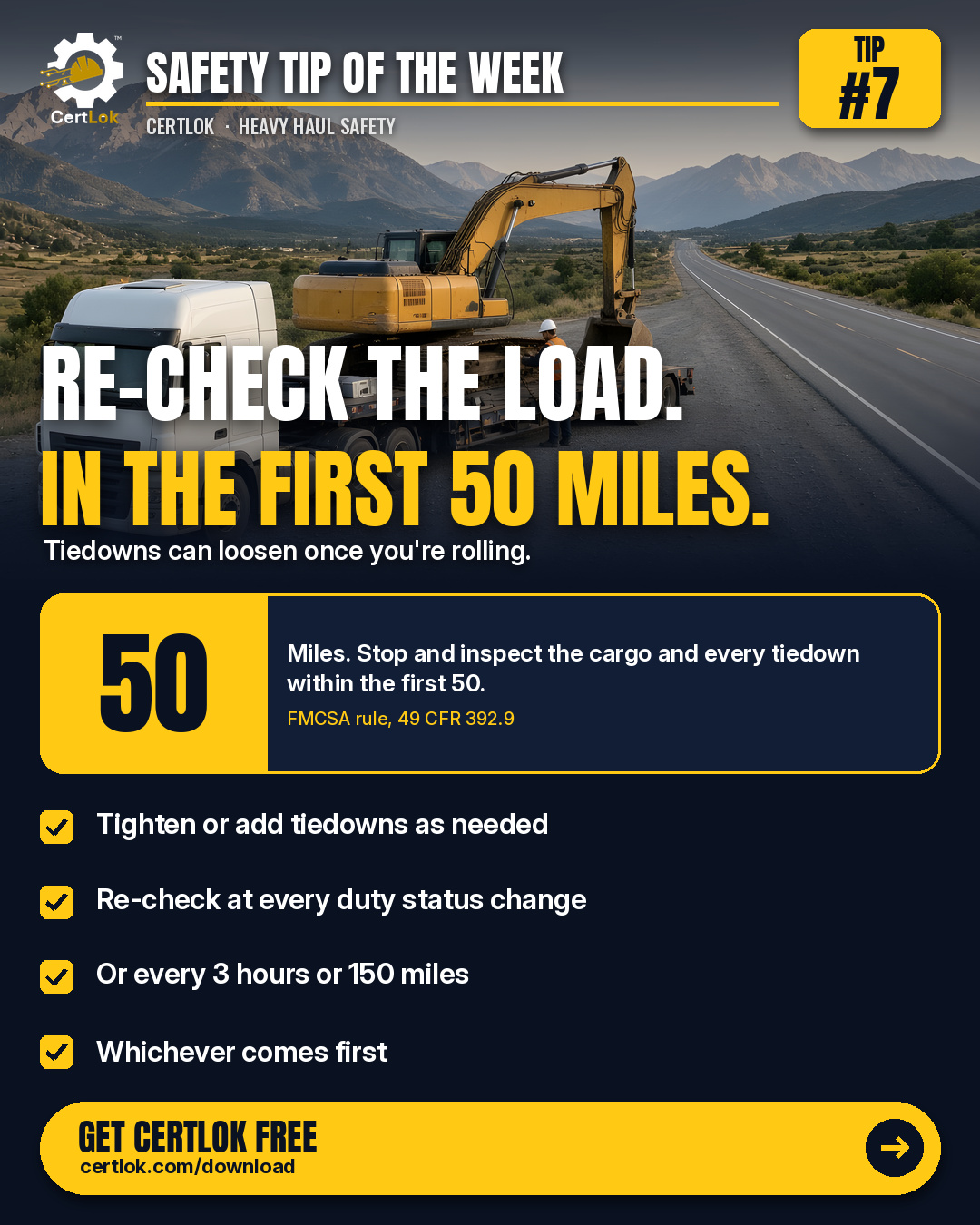
Federal Motor Carrier Safety Administration (FMCSA) rules in Title 49 of the Code of Federal Regulations (49 CFR 392.9) say to stop and inspect the cargo and every tiedown within the first 50 miles. After that, re-check whenever you change duty status, or after 3 hours or 150 miles of driving, whichever comes first.
On every trip:
Bottom line: tiedowns settle once you're rolling, so check them early and often.
Re-check every load, and keep your certifications current and in one place with CertLok.
Source: FMCSA, 49 CFR 392.9, inspection of cargo and securement

A good inspection takes a trained driver. With CertLok, heavy haul drivers keep their commercial driver's license (CDL) and certifications in one digital wallet on their phone and share them in seconds. No texting photo copies. No "I'll bring it tomorrow."
Then the driver can focus on the rig itself.
Federal Motor Carrier Safety Administration (FMCSA) rules in Title 49 of the Code of Federal Regulations (49 CFR 392.7, 396.11, and 396.13) say to make sure the vehicle is safe before driving, review the last driver vehicle inspection report, and sign it if defects were listed.
Every trip:
Bottom line: the defects you write up today are the breakdowns you avoid tomorrow.
Inspect every trip, and keep your certifications current and in one place with CertLok.
Source: FMCSA, 49 CFR 392.7, 396.11, and 396.13, vehicle inspections

Tires and brakes take a trained eye. With CertLok, heavy haul drivers keep their commercial driver's license (CDL) and certifications in one digital wallet on their phone and share them in seconds. No texting photo copies. No "I'll bring it tomorrow."
Then the driver can focus on the tires and brakes under the load.
Federal Motor Carrier Safety Administration (FMCSA) rules in Title 49 of the Code of Federal Regulations (49 CFR 393.75) say tires on the front wheels of a truck or truck tractor need at least 4/32 inch of tread depth, and all other tires need at least 2/32 inch, measured in a major tread groove. No tire may be flat, leaking audibly, separated, or cut deep enough to show the ply or belt.
At every stop:
Bottom line: heavy loads add heat and wear, so check tires and brakes often.
Check them at every stop, and keep your certifications current and in one place with CertLok.
Source: FMCSA, 49 CFR 393.75 and 392.7, tires and equipment checks
Getting the weight right takes a trained driver. With CertLok, heavy haul drivers keep their commercial driver's license (CDL) and certifications in one digital wallet on their phone and share them in seconds. No texting photo copies. No "I'll bring it tomorrow."
Then the driver can focus on the balance of the load.
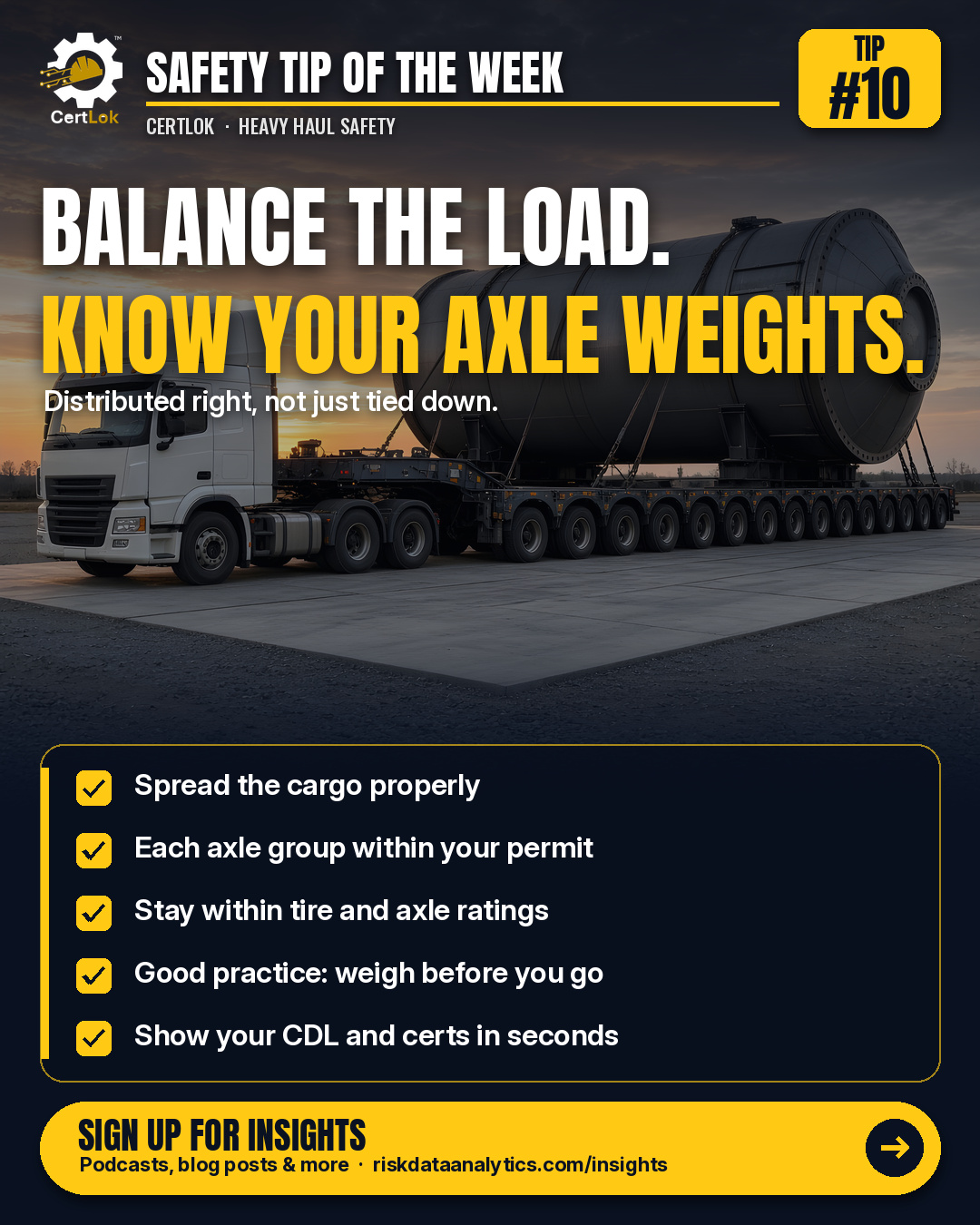
Federal Motor Carrier Safety Administration (FMCSA) rules in Title 49 of the Code of Federal Regulations (49 CFR 392.9(a)(1)) say cargo must be properly distributed as well as secured. Your state permit sets the weight for each axle group. Keeping enough weight on the steering axle and weighing before departure are good practice, not federal rules.
Before departure:
Bottom line: a load that's tied down but badly balanced is still a risk.
Balance every load, and keep your certifications current and in one place with CertLok.
Source: FMCSA, 49 CFR 392.9(a)(1), cargo distribution; your state permit sets axle weights
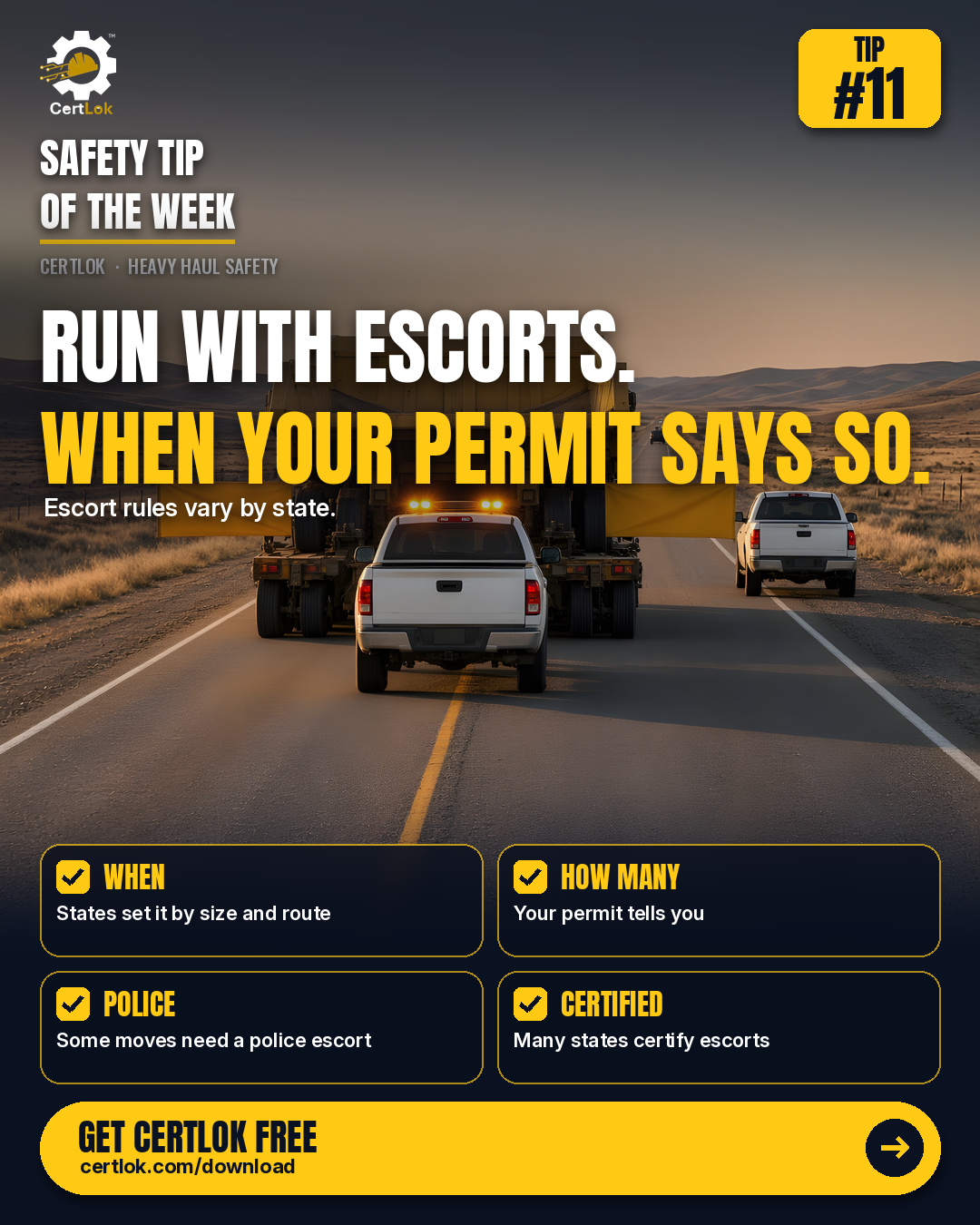
Every escort team counts on qualified people, and on proof of it. With CertLok, heavy haul drivers keep their commercial driver's license (CDL) and certifications in one digital wallet on their phone and share them in seconds. No texting photo copies. No "I'll bring it tomorrow."
Then the driver can focus on the escorts around them.
Pilot/escort best-practice guidelines from the Federal Highway Administration (FHWA) say states decide when escorts are needed based on width, height, length, and route. States also decide how many escorts you need and whether a police escort is required. Escort thresholds vary by state.
On every move:
Bottom line: escort rules vary by state, so your permit is the rulebook.
Follow every permit, and keep your certifications current and in one place with CertLok.
Source: FHWA, Pilot/Escort Vehicle Operators Best Practices Guidelines (2016), Part I
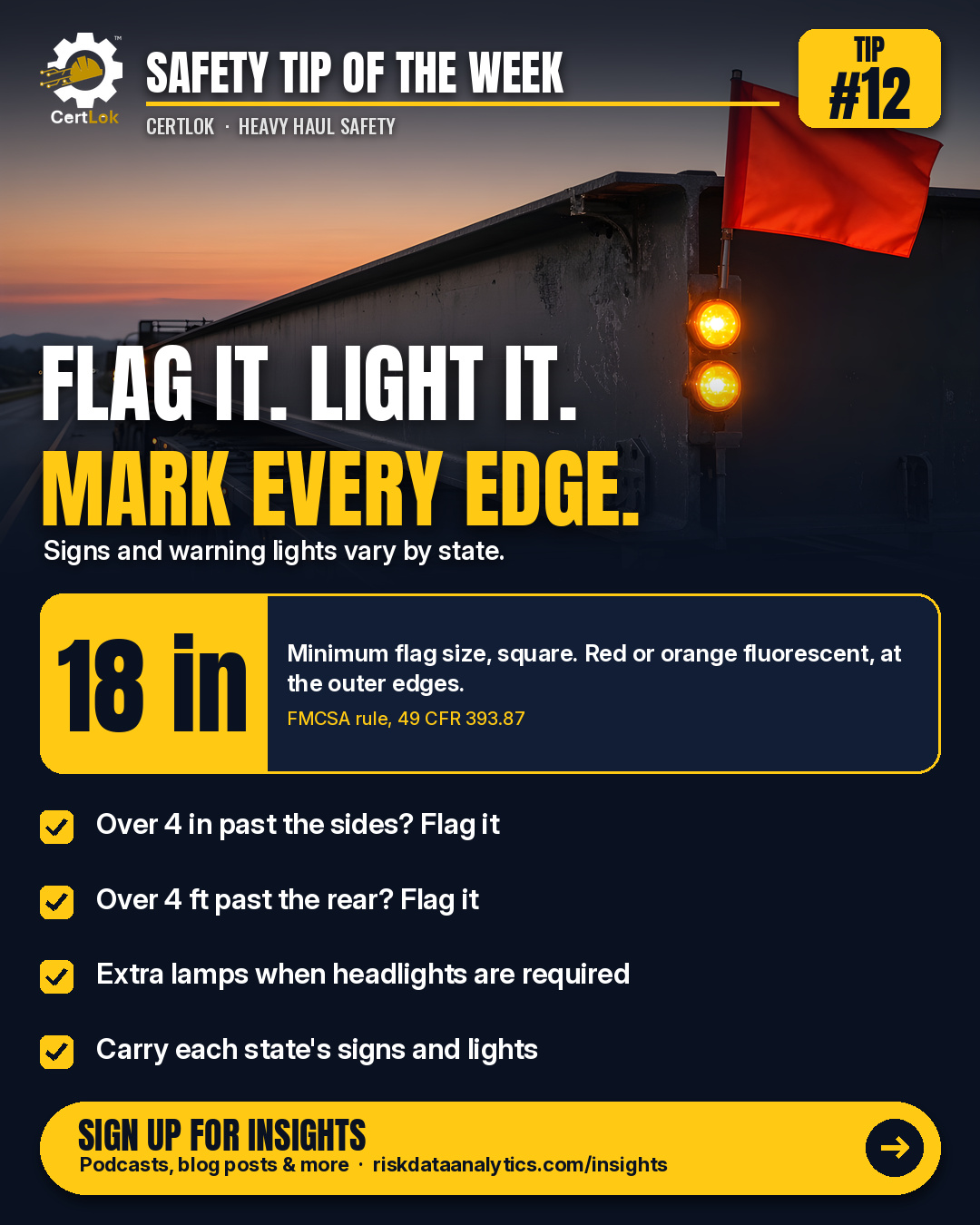
Marking the load takes a driver who knows the rules. With CertLok, heavy haul drivers keep their commercial driver's license (CDL) and certifications in one digital wallet on their phone and share them in seconds. No texting photo copies. No "I'll bring it tomorrow."
Then the driver can focus on the load being seen.
Federal Motor Carrier Safety Administration (FMCSA) rules in Title 49 of the Code of Federal Regulations (49 CFR 393.87 and 393.11) say a load that sticks out more than 4 inches past the sides or more than 4 feet past the rear needs red or orange fluorescent flags, at least 18 inches square, at its outer edges. Extra amber and red lamps are needed when headlights are required.
On every oversize load:
Bottom line: if other drivers can't see your load, they can't avoid it.
Mark every load, and keep your certifications current and in one place with CertLok.
Source: FMCSA, 49 CFR 393.87 and 393.11, flags and lamps on projecting loads

A good team meeting starts with qualified people. With CertLok, heavy haul drivers keep their commercial driver's license (CDL) and certifications in one digital wallet on their phone and share them in seconds. No texting photo copies. No "I'll bring it tomorrow."
Then the driver can focus on the team on the radio.
Pilot/escort best-practice guidelines from the Federal Highway Administration (FHWA) say to hold a meeting before rolling. The lead escort should keep a visual lead of at least 20 seconds, and every team member should be able to call a stop at any time.
Before rolling:
Bottom line: anyone on the team can call a stop, and everyone should know it.
Meet before every move, and keep your certifications current and in one place with CertLok.
Source: FHWA, Pilot/Escort Vehicle Operators Best Practices Guidelines (2016), Parts I to III
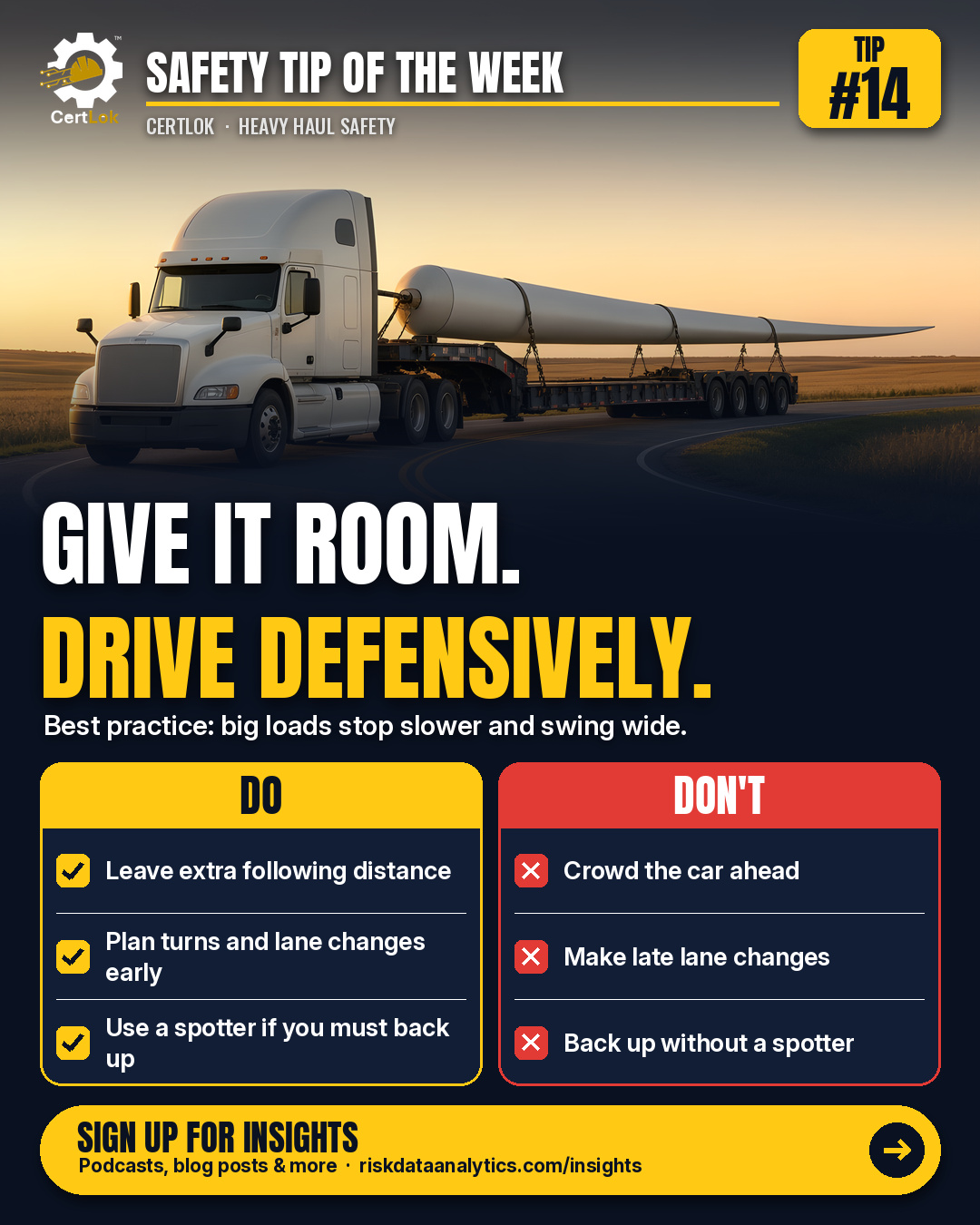
Defensive driving starts with a trained driver. With CertLok, heavy haul drivers keep their commercial driver's license (CDL) and certifications in one digital wallet on their phone and share them in seconds. No texting photo copies. No "I'll bring it tomorrow."
Then the driver can focus on the traffic around them.
Pilot/escort best-practice guidelines from the Federal Highway Administration (FHWA) point out that an oversize load takes longer to stop and accelerate, swings wide on turns, has bigger blind spots, and can roll backward when starting on a hill. These tips are best practice, not federal rules.
Best practice on the road:
Bottom line: a big load needs big room, so give it some.
Leave extra space every time, and keep your certifications current and in one place with CertLok.
Source: FHWA, Pilot/Escort Vehicle Operators Best Practices Guidelines (2016), Part III

Safe speed takes a trained driver. With CertLok, heavy haul drivers keep their commercial driver's license (CDL) and certifications in one digital wallet on their phone and share them in seconds. No texting photo copies. No "I'll bring it tomorrow."
Then the driver can focus on the road, not the clock.
Under Federal Motor Carrier Safety Administration (FMCSA) rules in Title 49 of the Code of Federal Regulations (49 CFR 392.6), obey posted speed limits and never let a schedule push you to speed. Also follow any lower speed your permit sets. Slowing down well before curves, ramps, grades, and work zones is best practice from the Federal Highway Administration (FHWA) pilot/escort guidelines.
On every move:
Bottom line: a tall or heavy load is more likely to roll over, so slow down early.
Watch your speed every time, and keep your certifications current and in one place with CertLok.
Sources: FMCSA, 49 CFR 392.6, schedules and speed; FHWA, Pilot/Escort Vehicle Operators Best Practices Guidelines (2016), Part III

Bad weather calls for a trained driver. With CertLok, heavy haul drivers keep their commercial driver's license (CDL) and certifications in one digital wallet on their phone and share them in seconds. No texting photo copies. No "I'll bring it tomorrow."
Then the driver can focus on the conditions.
Federal Motor Carrier Safety Administration (FMCSA) rules in Title 49 of the Code of Federal Regulations (49 CFR 392.14) say to reduce speed when snow, ice, sleet, fog, rain, dust, or smoke cut visibility or traction, and to stop if conditions become too dangerous. Many states restrict oversize moves in high wind, poor visibility, or icy conditions, with limits that vary by state and permit.
When the weather turns:
Bottom line: no delivery is worth driving into conditions your load can't handle.
Respect the weather every time, and keep your certifications current and in one place with CertLok.
Source: FMCSA, 49 CFR 392.14, hazardous conditions

Rested, trained drivers make safer moves. With CertLok, heavy haul drivers keep their commercial driver's license (CDL) and certifications in one digital wallet on their phone and share them in seconds. No texting photo copies. No "I'll bring it tomorrow."
Then the driver can focus on staying alert.
Federal Motor Carrier Safety Administration (FMCSA) rules in Title 49 of the Code of Federal Regulations (49 CFR 395.3 and 392.3) say to take 10 hours off duty before driving, drive no more than 11 hours, and not drive after the 14th hour since coming on duty. Never drive while too tired or ill to drive safely.
Every day:
Bottom line: a tired driver is a hazard no permit covers.
Rest up before every shift, and keep your certifications current and in one place with CertLok.
Source: FMCSA, 49 CFR 395.3 and 392.3, hours of service and ill or fatigued drivers

A clean record starts with safe crossings. With CertLok, heavy haul drivers keep their commercial driver's license (CDL) and certifications in one digital wallet on their phone and share them in seconds. No texting photo copies. No "I'll bring it tomorrow."
Then the driver can focus on the crossing ahead.
Federal Motor Carrier Safety Administration (FMCSA) rules in Title 49 of the Code of Federal Regulations (49 CFR 392.11 and 383.51) say to approach every crossing at a speed that lets you stop before the nearest rail. A conviction for failing to clear a crossing because of insufficient undercarriage clearance disqualifies a CDL holder for at least 60 days on a first offense.
At every crossing:
Bottom line: a low trailer and a humped crossing are a bad mix, so know where they are.
Cross with care every time, and keep your certifications current and in one place with CertLok.
Source: FMCSA, 49 CFR 392.11 and 383.51, railroad grade crossings and disqualification

Handling a breakdown takes a trained driver. With CertLok, heavy haul drivers keep their commercial driver's license (CDL) and certifications in one digital wallet on their phone and share them in seconds. No texting photo copies. No "I'll bring it tomorrow."
Then the driver can focus on warning traffic.
Federal Motor Carrier Safety Administration (FMCSA) rules in Title 49 of the Code of Federal Regulations (49 CFR 392.22 and 393.95) say to turn on hazard flashers as soon as you stop on the road or shoulder, and to place three reflective triangles within 10 minutes. Carry the required triangles and a charged fire extinguisher.
When you break down:
Bottom line: the first 10 minutes of a breakdown matter most.
Warn traffic fast, and keep your certifications current and in one place with CertLok.
Source: FMCSA, 49 CFR 392.22 and 393.95, emergency signals and equipment

Staying on route takes a focused, trained driver. With CertLok, heavy haul drivers keep their commercial driver's license (CDL) and certifications in one digital wallet on their phone and share them in seconds. No texting photo copies. No "I'll bring it tomorrow."
Then the driver can focus on the permitted route.
Federal Motor Carrier Safety Administration (FMCSA) rules in Title 49 of the Code of Federal Regulations (49 CFR 392.80 and 392.82) ban texting and holding a mobile phone while driving, except to contact police or emergency services. Your state permit sets your route.
On every move:
Bottom line: unapproved roads may have bridges and clearances no one checked for your load.
Stay on the permitted route, and keep your certifications current and in one place with CertLok.
Source: FMCSA, 49 CFR 392.80 and 392.82, texting and hand-held phones; your state permit sets the route
Keep your safety certifications in one digital wallet on your phone, ready to share in seconds.
Download CertLok freeSign up for Insights