
Credentials and Certifications
By Risk Data Analytics, Inc. Article 011
Ask any journeyman lineman how they got there and you will hear about years of climbing, storm work, and learning from the person on the next pole. There is no shortcut, but the path is clear. You get in, you serve an apprenticeship that mixes field work and classroom time, and you come out at journey level. Here is that path, laid out from official sources.
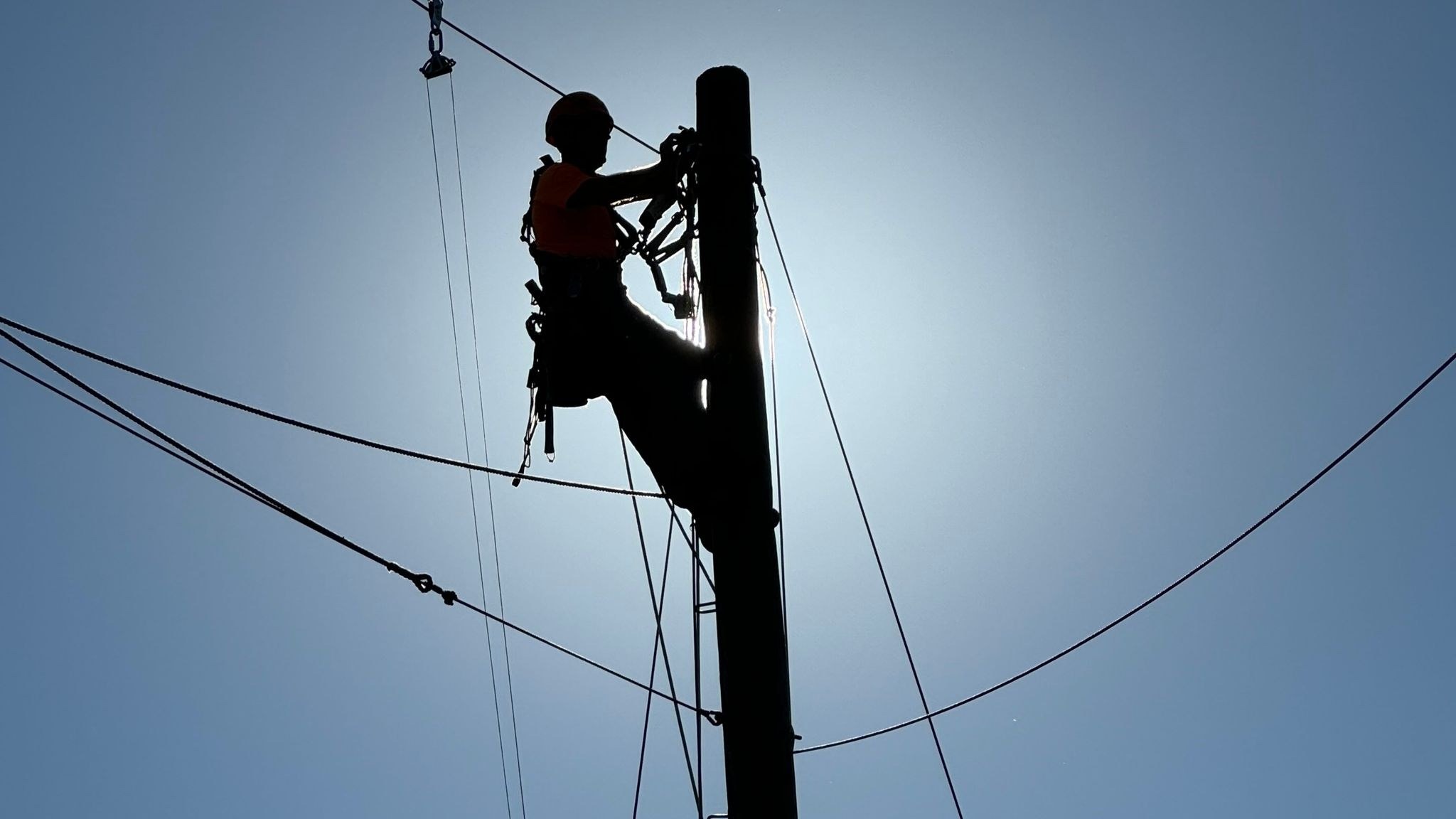
The U.S. Bureau of Labor Statistics (BLS) describes electrical power-line installers and repairers as workers who install or repair the cables and wires used in electrical power and distribution systems, and who may also put up poles and transmission towers [1]. The work means high-voltage electricity, often at great heights, in all kinds of weather, including after storms [1]. The Electrical Training Alliance, the training program of the International Brotherhood of Electrical Workers (IBEW) and the National Electrical Contractors Association (NECA), says outside linemen build and maintain the distribution and transmission lines that carry power from the plant to homes and businesses, and that much of the work is on top of wooden poles, so climbing is a core skill [2][3].
BLS says workers typically need a high school diploma or equivalent to enter the occupation [1]. Employers may prefer people who know basic algebra and trigonometry [1]. Some community colleges offer 1-year certificate or 2-year associate's degree programs that cover electrical distribution, line construction, and pole top and bucket rescue [1].
For an IBEW and NECA apprenticeship, the Electrical Training Alliance lists these typical requirements [2]:
Each local program may add its own requirements [2]. Some programs also require a physical exam, a background check, or a valid driver's license [4]. BLS adds that apprentices may have to pass a fitness test [1].
With IBEW and NECA, you apply to your local Joint Apprenticeship Training Committee (JATC) or Area Wide Joint Apprenticeship Training Committee (AJATC) [2]. The application process works like this [4]:
Some of the minimum requirements can be waived if you have documented work hours in electrical construction [4].
You can also look for apprenticeships through your state apprenticeship agency, local unions, or employers, and search at Apprenticeship.gov, which BLS points to as a source [1].
BLS says line workers typically complete apprenticeships or other employer-sponsored training that combines on-the-job training with technical instruction, sometimes run jointly by the employer and the union [1]. BLS puts these programs at up to three years [1]. The Electrical Training Alliance says its Outside Lineman apprenticeship runs three and a half years [4]. Program length depends on the program you join.
During the apprenticeship you work under the supervision of a journey-level lineman [3]. The Electrical Training Alliance lists some of the key knowledge areas as working with energized circuits, emergency rescue, first aid, transformer connections, knowing when a wooden pole is unsafe to climb, job safety rules, hand signals for ground crews and equipment operators, knots, and reading blueprints [4]. Key skills include working on high-voltage lines while wearing rubber gloves and other protective equipment, CPR (cardiopulmonary resuscitation), rigging, running a bucket truck, splicing high-voltage cable, and driving a truck [4].
Federal safety rules shape this training too. Under OSHA (Occupational Safety and Health Administration) rules for power transmission and distribution work in construction, every employee must be trained in the safety practices for their job, including emergency procedures such as pole-top and manhole rescue [5]. To count as a "qualified" employee, a worker must also be trained and competent in telling exposed live parts from other parts, determining voltage, keeping the minimum approach distances, using protective equipment and insulated tools, and recognizing and controlling electrical hazards [5]. The employer must make sure each employee has shown proficiency before the training counts as complete [5].
Line crews drive heavy trucks. BLS says workers who drive heavy vehicles usually need a state-issued commercial driver's license (CDL), and those who drive crews across state lines need an interstate CDL, which may carry added requirements from the Federal Motor Carrier Safety Administration [1]. Other requirements, such as medical certifications and minimum age, vary by state [1].
BLS says that after three or four years of work, qualified apprentices reach the journey level [1]. A journey-level worker is no longer an apprentice and can do most tasks without supervision [1]. Experienced linemen may go on to become supervisors or trainers [1]. The Electrical Training Alliance reports that 92 percent of journey-level outside linemen say they supervise other journey-level workers and apprentices [3].
Finishing the apprenticeship and reaching journey level shows you have completed the on-the-job training and classroom instruction your program requires and can work most tasks on your own [1]. BLS notes that separate certification for line workers is available but not mandatory [1]. Your CDL shows you are licensed to drive the heavy vehicles the job uses [1].
Reaching journey level is not the end of training. Under OSHA's rules for this work [5]:
The Electrical Training Alliance also offers journeyman training for workers past their apprenticeship [2]. Keep your CDL and any state medical requirements current as well [1].
Between your commercial driver's license (CDL), journeyman certification, and safety training certifications, it adds up. CertLok is a free credential wallet for the trades, where those certifications can live on one phone, including a National Commission for the Certification of Crane Operators (NCCCO) certification if you hold one. We verify credentials like your CCO card and CDL.
Download CertLok free at certlok.com/download
Sign up for the weekly Insights email at riskdataanalytics.com/insights.
Photo: Bradd Morse on Pexels